
You want a synth to say something. Not a vocoder, not a talkbox, just a patch that sounds like a voice.
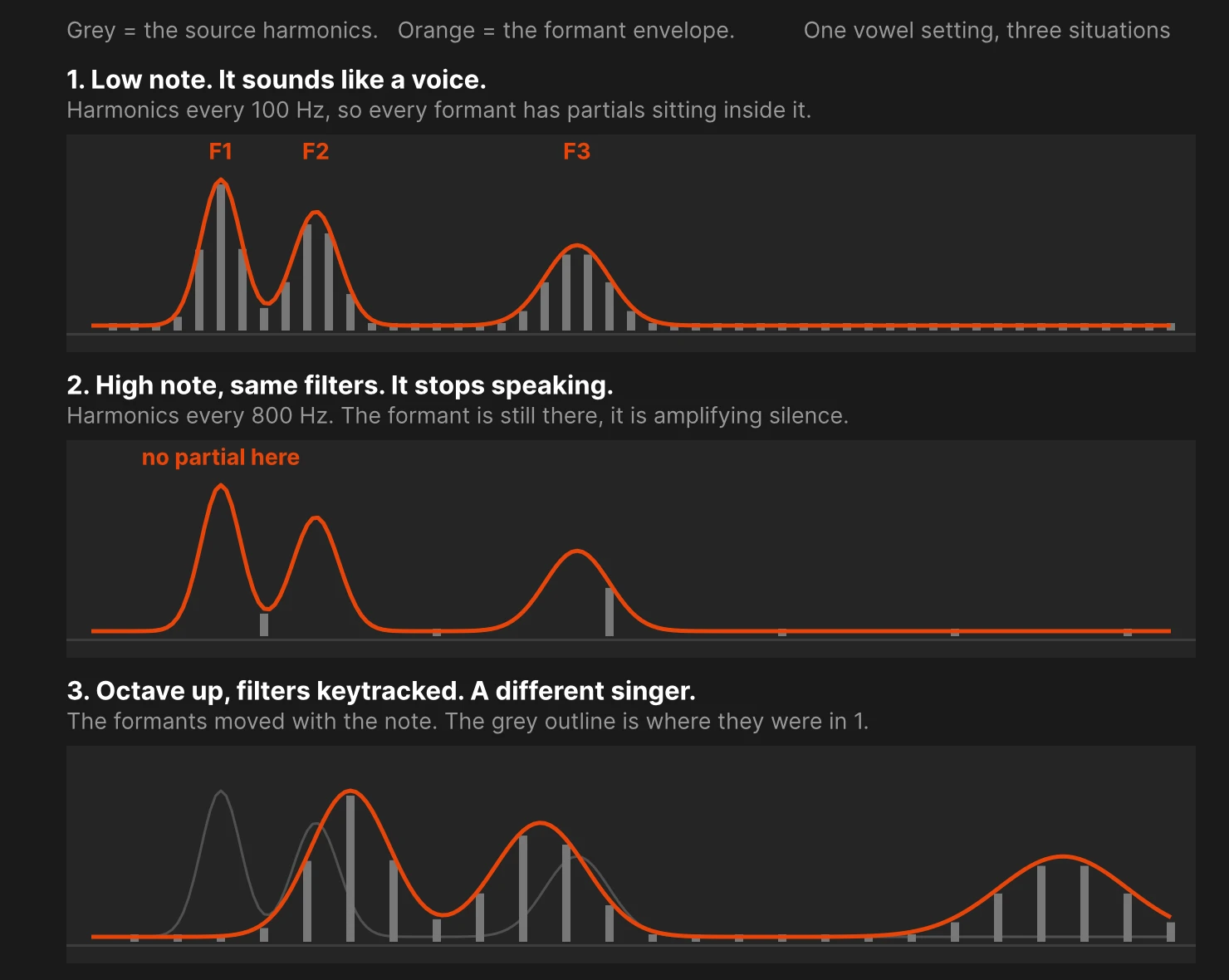
So you do the obvious thing. Three bandpass filters, tuned to the numbers you found for the vowel "ah", fed by a saw, and you keytrack them so they follow the part. You play a note and there it is. You play the same patch an octave up and it is still a good sound, but the voice has gone out of it. What you have now is a synth with three resonant peaks travelling with the note.
Both of those are worth making. They are just not the same instrument, and one setting decides which one you end up with: whether the filters follow the note or stay where you put them.
Everything below is why that one setting decides it, and how to aim it in either direction.
The source and the filter are two different things
The standard description of how a voice works is the source-filter model, laid out by Gunnar Fant in 1960 and still the model everyone builds on.
There are two parts.
The source is the raw sound. For a voiced sound it is your vocal folds buzzing, a harmonically dense tone whose rate is the pitch you are singing. For an unvoiced sound like "s" or "f" it is turbulent noise with no pitch at all.
The filter is everything above the folds: throat, mouth, tongue position, lips. It is a tube with resonances. Those resonances are the formants, numbered from the bottom up: F1, F2, F3.
The whole point of the model is that these two parts are independent. The source decides what note you are on. The filter decides which vowel it is. Neither one knows much about the other.
You can check this on yourself in about five seconds, and you should, because it makes the rest obvious.
Say "eeee" and slide your voice from the bottom of your range to the top. The pitch moves. The vowel does not. It is still "eeee" the whole way.
Now whisper "ah, ee, oo". No pitch at all, no vocal fold buzz at all, just noise going through the same tube. Still perfectly recognisable vowels.
Source and filter. Two knobs, two jobs.
Why this kills keytracking
If the formants belong to the shape of your mouth, they do not care what note you are singing. Your vocal tract does not get longer when you go up a fifth.
So when you keytrack your bandpass filters, you are telling the patch that the singer's head changes size with every note. An octave up, your "ah" formants land where a much smaller person's would be. The listener does not hear "same voice, higher note". They hear a different speaker on every note, which is to say, not a speaker at all.
This is the most common mistake in vocal patch programming, and it is invisible while you are working, because you tune the patch on one note and it sounds great on that note.
None of which makes it a bad sound
Keytracked bandpass filters make a real instrument, and a good one. Move the resonances with the note and every note comes out with the same colour relative to its own fundamental: a bright, resonant, vaguely vocal lead that stays consistent across the whole keyboard. That is a large part of the sung-synth sound in dance music, and it is what a lot of factory "vowel" presets are actually doing.
It just is not a voice. A voice is a fixed tube played by a moving source. A keytracked patch is a moving tube, which is an instrument nobody has and nobody's ear has a reference for. That is exactly why it sounds synthetic, and synthetic is a legitimate thing to want.
So the rule below is a fork, not a ban. Decide which of the two you are making, then set the filters on purpose. The mistake is only a mistake when you wanted the first one and got the second without noticing.
The rule, when you want a voice: the source keytracks, the formants do not.
The numbers, and what they are worth
Here are formant values for the vowels of a bass and a tenor voice, from the formant tables in the Csound documentation. Frequencies in Hz.
| Voice | Vowel | F1 | F2 | F3 |
|---|---|---|---|---|
| Bass | a | 600 | 1040 | 2250 |
| Bass | e | 400 | 1620 | 2400 |
| Bass | i | 250 | 1750 | 2600 |
| Bass | o | 400 | 750 | 2400 |
| Bass | u | 350 | 600 | 2400 |
| Tenor | a | 650 | 1080 | 2650 |
| Tenor | e | 400 | 1700 | 2600 |
| Tenor | i | 290 | 1870 | 2800 |
| Tenor | o | 400 | 800 | 2600 |
| Tenor | u | 350 | 600 | 2700 |
Read the table across rather than down and you can see the vowel space directly. F1 goes up as the mouth opens ("i" at 250, "a" at 600). F2 goes up as the tongue moves forward ("u" at 600, "i" at 1750). Every vowel you can say is a position in that two-dimensional space, which is exactly why vowel charts are drawn as a plane and not as a list.
Two things these numbers are not.
They are not a target you have to hit exactly. The classic measurement study here is Peterson and Barney in 1952, who recorded 76 American English speakers, 33 men, 28 women and 15 children, saying ten vowels twice each. The scatter within a single vowel is wide, and the categories overlap. There is no correct F1 for "ah", there is a region.
And they are not universal. Women and children have shorter vocal tracts, so their formants sit higher across the board. That is the actual difference between a "male" and a "female" vowel setting in any formant tool: not a timbre preset, a different tube length.
The part nobody answers: what about other registers?
This is the question that gets asked on forums and left hanging. If formants are fixed, why does a formant patch still sound wrong when you move a long way up or down, even with keytracking off?
Two reasons, and they are different.
First, real voices do move their resonances a little. Not proportionally to the note, but they move. The extreme case is well documented in classical singing: sopranos at the top of their range deliberately raise the first resonance to line it up with the fundamental, which makes them louder for less effort. It is a resonance strategy, not a diction problem, and it has a cost. In one listening study, tuned versions of the vowel "ee" were preferred and judged more natural, but listeners identified the vowel correctly more often in the versions that were not tuned.
The practical version for a patch: a small amount of keytracking, on the order of ten to twenty percent, is a better compromise across four octaves than zero. But it is a garnish. If it is above fifty percent you are back to building a new singer per note.
Second, and more often the real culprit: the filter has nothing to work with. A resonance does not create energy, it boosts what passes through it. A note at 100 Hz gives you harmonics every 100 Hz, so a formant at 600 Hz has plenty of partials sitting inside it. A note at 800 Hz gives you harmonics every 800 Hz, and a formant at 600 Hz may have nothing anywhere near it.
The formant is still there. It is just amplifying silence.
This is not a synth problem, it is a physics problem, and it happens to real singers too: the wide spacing of harmonics at high pitch is one of the accepted reasons vowels get harder to identify as sopranos go up. Which tells you where the fix is. Not at the filter, at the source. Denser source, more partials, more for the formants to catch. A supersaw with detuned voices works where a single clean saw does not, for exactly this reason.
Five things that actually make a patch speak
- Use a dense source. Saw, narrow pulse, supersaw, or noise. A sine has nothing to filter. If your patch sounds thin and vowel-less, look at the oscillator before you look at the filters.
- Turn keytracking off on the formant filters. Then, if you need it, add a little back. Not more. Full tracking is a different instrument, not a better version of this one.
- Use bandpass filters in parallel, not in series. Formants are peaks added on top of each other, not a chain of narrowings. Three bandpasses in series give you the intersection of three windows, which is one narrow window, not a vowel.
- Move. A held, static vowel reads as a filter. A vowel that travels reads as a mouth, because that is what mouths do: they are always going somewhere. Even a slow drift between two vowels does more for the illusion than a perfectly tuned static one.
- Add the noise. Voiced sound alone gives you singing at best and humming at worst. Consonants are the noisy, non-pitched part, and they are most of what makes speech read as speech. That is a whole subject on its own, and it is the thing that breaks vocoders.
Where this leaves the tools
Everything above is doable by hand in any DAW, with parallel bandpass filters and enough patience. Vowel Blender is what happens when you get tired of the patience: you move through a vowel space with one gesture instead of retuning three filters, across 10 IPA vowels and 4 formants. The announcement post covers what it is and how it is played.
Two of its controls are this article turned into knobs, and they are worth naming.
The seven voice models are seven vocal tracts. Woman 1 to 3, Man 1 to 3 and Kids are not timbre presets. Each one is a measured set of formant frequencies for the same ten vowels, built from published voice data, including the Peterson and Barney study cited above. Switching model is the tube-length difference described earlier, not a filter tweak.
SHIFT is the continuous version of that. It transposes all four formants together, plus or minus 12 semitones. Down is a longer vocal tract, up is a shorter one. The models are fixed points measured from real voices; SHIFT is the continuous stretch you apply to whichever one you picked.
Keytrack is a routing, not a switch. It is one of four play sources on the MIDI card, alongside velocity, aftertouch and mod wheel, and each one goes to a destination you choose, with its own depth and response curve. Send keytrack to SHIFT and you get the small residual tracking recommended above, at whatever amount you decide.
One number to save you an afternoon. That depth is not a percentage of keytracking. With the default keytrack spread of 48 semitones and SHIFT's range of plus or minus 12 semitones, full depth gives you roughly a quarter of true one-to-one tracking. So the ten to twenty percent above lands around 0.4 to 0.8 depth, not 0.1 to 0.2. Set it, play two octaves apart, and trust your ears over both numbers.
One catch worth knowing before you try any of it: an effect plugin does not receive your keyboard by default, and getting the notes there is its own small problem. That is the previous article. The manual has the routing details.
Frequently asked questions
What is the source-filter model?
It is the standard description of how speech is produced. A source makes a raw sound, either the buzz of the vocal folds or turbulent noise, and the vocal tract filters it. The source sets the pitch, the filter sets the vowel, and the two are largely independent.
Do formants change when you sing higher?
Not much, and not proportionally. Your vocal tract is the same shape whatever note you sing, so the resonances stay roughly where they are. That is why a vowel stays recognisable across your whole range. Trained sopranos are the documented exception: at very high pitch they move the first resonance up to meet the fundamental, which makes them louder for less effort.
Why does my vocal synth patch stop working an octave up?
Either you keytracked your bandpass filters, so the patch now describes a different vocal tract at every pitch, or your source has become too sparse and there is no partial near the formant for it to amplify. Check the second one first, it is the one people miss.
Should I keytrack a formant filter?
It depends what you are making. If you want a voice, no: zero is much closer to correct than one hundred, and ten to twenty percent is a reasonable compromise over a wide range. If you want a resonant lead that keeps the same colour on every note, full keytracking is the right answer and a good sound in its own right. It is just not a voice.
Which source waveform works best?
Anything harmonically dense: sawtooth, narrow pulse, supersaw, noise. A filter can only boost energy that is already there.
Is a formant filter the same as a vocoder?
No. A formant filter imposes a fixed set of resonances that you choose. A vocoder measures the resonances of one signal, in bands, and applies them to another in real time. The vocoder is doing analysis, the formant filter is not.
Sources
- Gunnar Fant, Acoustic Theory of Speech Production, Mouton, 1960, for the source-filter model.
- Csound, Formant Values, for the bass and tenor formant tables.
- Gordon E. Peterson and Harold L. Barney, "Control Methods Used in a Study of the Vowels", Journal of the Acoustical Society of America, 1952. Study design as summarised in the Praat documentation of the dataset.
- Rebecca R. Vos, Damian T. Murphy, David M. Howard and Helena Daffern, "The Perception of Formant Tuning in Soprano Voices", Journal of Voice, volume 32 issue 1, 2018, for resonance tuning and its cost in vowel identification.
Joy to use, joy to hear.
Ben, UB DSP