
Today we release Vowel Blender, the second UB DSP plugin. It is a formant filter plugin built around one idea: the vowel sound should be something you play, not something you preset.
What Vowel Blender Is
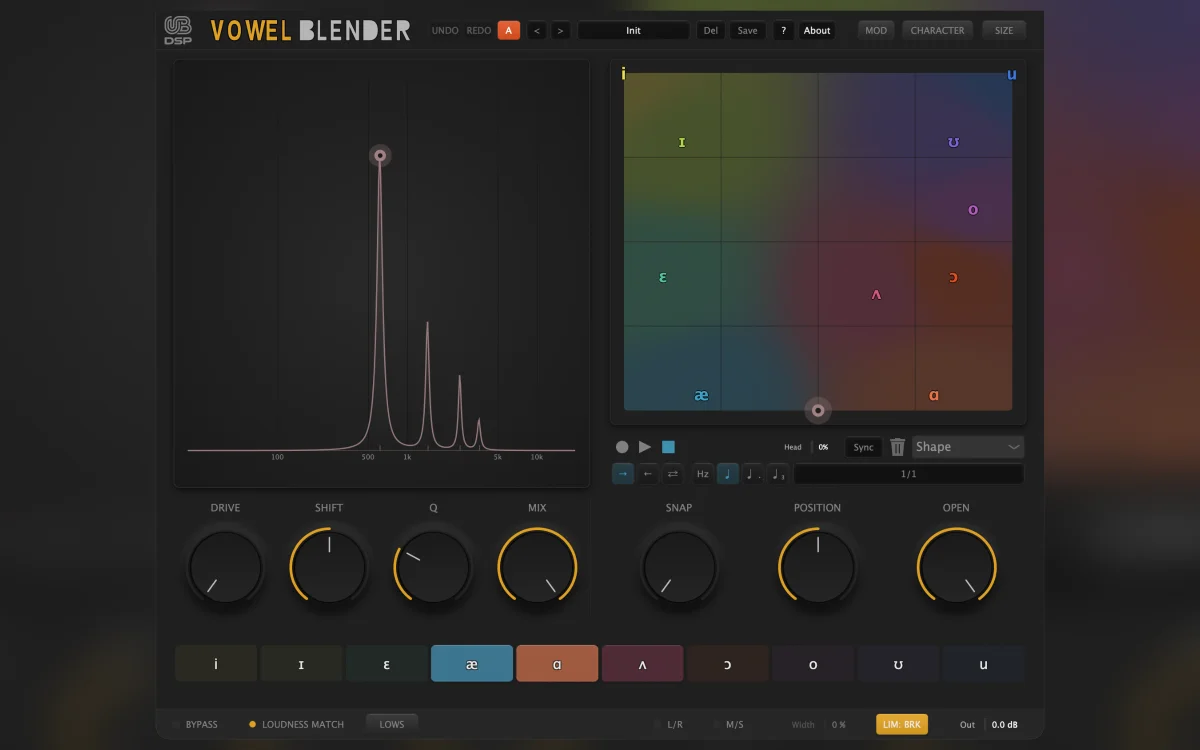
Vowel Blender is a formant filter plugin that imposes vocal vowel timbres on any audio source. The interface centres on a two-dimensional phonetic pad shaped like the IPA vowel quadrilateral. Drag the cursor between vowels and the formants morph in real time, smoothly and naturally. The result is a synth, bass, drum loop, or guitar that sounds like it is singing.
Most existing formant filters give you a list of vowels and a morph slider. You pick a set, you move the slider, and that is the extent of the interaction. Vowel Blender takes the opposite approach. The vowel itself is the playing surface, and every parameter on the pad can be recorded, looped, or modulated.
A 2D Phonetic Pad Built on the IPA Vowel Chart
The IPA vowel chart is the standard map linguists use to describe every vowel sound in human language. Its horizontal axis runs from front vowels (like /i/ in "see") to back vowels (like /u/ in "blue"). Its vertical axis runs from close (high) vowels to open (low) vowels.
Vowel Blender places ten phonemes at their real positions on this chart and lets you move freely between them. Click anywhere on the pad and you hear that exact vowel, voiced by your chosen model. Park the cursor at a corner for pure /i/ or /u/. Park it in the middle for something that does not exist in any natural language but still sounds like a voice.
Seven Voice Models from Peer-Reviewed Phonetics Research
A vowel is not just a set of frequencies. The same /a/ sounds different from a woman, a man, or a child because the size and shape of the vocal tract change the formant positions. Vowel Blender ships with seven voice models: three women, three men, and one kids model.
Formant data comes from two peer-reviewed phonetics studies:
- Peterson and Barney (1952), "Control Methods Used in a Study of the Vowels", Journal of the Acoustical Society of America. Source of the male voice models.
- Hillenbrand, Getty, Clark, and Wheeler (1995), "Acoustic characteristics of American English vowels", Journal of the Acoustical Society of America. Source of the female and child voice models.
Switching voice models is one click. The pad layout stays the same, but every formant moves to match the new anatomy. Pick the voice that fits the source, or pick one that does not, and let the mismatch become the effect.
A Motion Recorder That Loops in Tempo
Below the phonetic pad is a record button. Press it, drag the cursor wherever you want, press stop. The path you drew becomes an editable trajectory that loops in tempo with your DAW. Forward, backward, ping-pong. Free Hz, or sync from 1/8 to 8 bars.
If drawing is not your thing, thirteen built-in shapes are one click away. Smooth curves like Spiral and Figure-8 for organic motion. Geometric loops like Triangle and Square for rhythmic phrasing. Vocal paths like Diphthong for natural speech transitions. Drop one, then bend it.
Nine Modulators You Can Route Anywhere
Anything you can do on the pad with your mouse, you can do with a modulator. Vowel Blender ships with nine source types, all multi-instance, all drag-and-drop:
- LFO: classic low-frequency oscillator, multiple shapes and tempo sync.
- MSEG: free-form drawn envelope with five segment shapes, loop markers, and tempo sync.
- Step Sequencer: programmable step values for rhythmic motion.
- Audio Oscillator: audio-rate modulation for FM-style timbres.
- Envelope Generator: ADSR triggered by MIDI or transients.
- Envelope Follower: tracks the dynamics of the input signal.
- Macro: one knob, four routable sub-outputs.
- MIDI: any MIDI CC or note value as a modulator.
- XY Pad: a second 2D controller you can automate or perform.
Modulators can route into other modulators. A step sequencer feeds a macro, the macro feeds an LFO, the LFO drives the X axis. The result is a performable, automatable behaviour that is yours and only yours.
Character Controls That Push Past Realism
Four secondary controls expand the sound beyond what a human voice can produce:
- Humanize: adds slow drift to the formants so they never sit perfectly still.
- Size: scales the vocal tract from a child to a giant, shifting all formants together.
- Alien: pushes the formants past anatomical limits into something that has never spoken.
- Drive: a soft saturation at the input, useful for thickening clean sources.
One main control sits above all of them: Shift pitches the source by plus or minus 12 semitones before the filter touches it. The vowel timbre stays grounded while the pitch moves. About 12 ms of latency when engaged, zero CPU when off.
How Vowel Blender Compares
Three categories of plugin come close to what Vowel Blender does. None of them solve the same problem the same way.
- Vocoders need two signals: a carrier and a modulator (a voice). Vowel Blender needs only one. There is no microphone, no tube, no extra signal routing.
- Talkboxes require a live performer with a tube in their mouth. Vowel Blender models the same vowel shapes in software, controllable by mouse, MIDI, automation, or any of nine modulators.
- Existing vowel filters typically offer three formants and a list of preset vowel positions. Vowel Blender uses four formants per vowel, ten phonemes on a continuous 2D pad, and seven voice models from published research.
Use Cases on Real Sessions
Vowel Blender is not an EQ. You will not reach for it daily. But the producers who use a formant filter tend to put it on the records that stand out.
- Talking bass: drop it on a sub bass, automate the pad between /a/ and /u/, and the bassline starts to phrase.
- Singing pads: long sustained pads gain breath and intent when slowly morphed through three or four vowels.
- Speaking drums: a step sequencer routed to the X axis turns a drum loop into a stuttering vocal phrase.
- Vowelised leads: morphing the pad in time with the melody adds a vocal quality without any actual singing.
- Sound design: alien voices, creature sounds, screaming pads, ghostly whispers. The Size and Alien knobs are designed for this.
Formats, Platforms, and Licensing
Vowel Blender ships as CLAP, VST3, AU, and AAX. It runs on macOS (Apple Silicon and Intel), Windows, and Linux. The DSP is written in Rust, the GUI in C++ on JUCE 8.
Licensing is offline. No iLok, no dongle, no internet activation. You buy it, you get a keyfile, you load the keyfile in the plugin. It works offline forever. The optional update checker and opt-in anonymous telemetry are entirely under your control, off by default until you say otherwise.
A free unlimited trial is available on the Downloads page. It is the full plugin with a brief silence inserted every forty seconds. Run it in your own session, on your own material, for as long as you want. Decide for yourself.
Frequently Asked Questions
What is a formant filter?
A formant filter is an audio effect that imposes the resonant frequencies of the human vocal tract, called formants, onto any input signal. By tuning a small set of resonant peaks, it makes any sound source take on the timbre of a spoken or sung vowel.
How is Vowel Blender different from a vocoder?
A vocoder needs two signals: a carrier and a modulator (a voice). It analyses the voice and applies its spectral envelope to the carrier. Vowel Blender needs only one input. It applies a fixed bank of vowel formants directly. The result sounds like a sung vowel rather than a robotic blend of two signals.
How is Vowel Blender different from a talkbox?
A talkbox routes audio through a tube into a performer's mouth, so the mouth shape modulates the sound. It requires a live player. Vowel Blender models the same vowel shapes in software through a 2D phonetic pad, with no microphone, no tube, and no performer needed.
What audio plugin formats does Vowel Blender support?
Vowel Blender ships as CLAP, VST3, AU, and AAX. It runs on macOS (Apple Silicon and Intel), Windows, and Linux.
Does Vowel Blender require iLok or an internet connection?
No. Vowel Blender uses an offline keyfile licence. No iLok, no dongle, no internet activation. The plugin runs offline forever after the keyfile is loaded once.
How many vowels and voice models does Vowel Blender include?
Vowel Blender includes 10 vowels mapped to their IPA chart positions, four formants per vowel, and 7 voice models (three women, three men, one kids model) sourced from Peterson and Barney (1952) and Hillenbrand et al. (1995).
Availability and Pricing
Vowel Blender is available now for $68. One-time purchase. Free lifetime updates. No subscription. 30-day money-back guarantee.
Joy to use, joy to hear.
Ben, UB DSP