
Two forum threads, two languages, the same question.
The first, on Gearspace, asks what the difference is between second and third order harmonic distortion, how you are supposed to hear it, and whether it is true that transistors give you second order and tubes give you third.
The second, in French on Audiofanzine, comes from someone who has read two contradictory explanations and wants to know which one is right. The reply they get: distortion is made of even harmonics, which the ear finds unpleasant, and tubes guarantee odd harmonics, which are pleasant.
Look at what just happened. Both threads state the folklore backwards, and they state it backwards in opposite directions. The received wisdom almost everywhere else is the reverse of both: tubes give you even harmonics, and those are the nice ones.
Three versions of the same claim, all confident, none agreeing. That is what a belief looks like when it is made of adjectives instead of a model. "Warm" and "harsh" are not information. You cannot check them, you cannot predict with them, and you cannot rebuild one from the other, which is why the folklore drifts.
Here is the model, in three lines.
- Every harmonic is a musical interval above the note you played. The second is an octave, the third is a fifth, the fifth is a major third. That is checkable, and it tells you what the distortion will do to your harmony.
- What decides even versus odd is the symmetry of the transfer curve, not what the circuit is made of. Symmetrical gives you odd. Asymmetrical gives you both.
- None of it survives a chord. On anything more complex than one note, most of what you hear is intermodulation, and intermodulation does not play by the harmonic series.
If you have read the source-filter piece, this is its other half. A filter only shapes energy that is already there. A nonlinearity is the thing that creates energy that was not. This article is about exactly what it creates.
The harmonic series is a chord, and here it is
A harmonic is a whole-number multiple of the fundamental. Multiply a frequency by a small whole number and you land on a musical interval, because that is what intervals are.
Play a low C. Here is what each harmonic is, as a note.
| Harmonic | Ratio | Interval above the fundamental | Cents off equal temperament |
|---|---|---|---|
| 2 | 2:1 | one octave | 0 |
| 3 | 3:1 | octave plus perfect fifth | +2 |
| 4 | 4:1 | two octaves | 0 |
| 5 | 5:1 | two octaves plus major third | −14 |
| 6 | 6:1 | two octaves plus perfect fifth | +2 |
| 7 | 7:1 | two octaves plus minor seventh | −31 |
| 8 | 8:1 | three octaves | 0 |
Read the interval column down to harmonic 6 and you have spelled a major triad: root, fifth, third, fifth. The first six harmonics of a note are a major chord on that note. This is not a metaphor and it is not a coincidence, it is why the major triad is the chord it is.
Now read the last column. The fifth harmonic is 14 cents flatter than the major third on your keyboard, which is close enough to fuse. The seventh is 31 cents flat, about a third of a semitone, and that is not close to anything on your keyboard. Wikipedia's harmonic series article puts it plainly: the twelve equal semitones are "slightly out of tune with many of the harmonics, especially the 7th, 11th, and 13th harmonics".
Keep those three numbers. 7, 11 and 13 are where the series leaves your key, and they are the real source of what people call harshness.
What each one actually adds
Harmonics 2, 4 and 8. These are pure octaves. They restate the note you played, higher. Add them and the note gets bigger, fuller and easier to hear on a small speaker, and the harmony does not change at all, because you have not added a new pitch class. This is what people are describing when they say "warm" or "thick", and it is the only part of the folklore that survives contact with the table.
Harmonics 3 and 6. A perfect fifth, two cents wide. Adding a fifth to every note in a part is exactly what an organ stop does, and it sounds like one: hollow, reedy, and much more present in a mix than an octave, because a fifth is a new pitch class and your ear tracks it as a separate line. On a bass, a strong third harmonic is how the part survives on a phone. On a pad that is already voiced with fifths, it is mud.
Harmonics 5 and 10. A major third, 14 cents flat. This is the one that changes your music, and almost nobody says so. Feed a minor chord through a distortion rich in fifth-order content and you are adding major thirds to minor triads. It does not sound wrong exactly, it sounds sour, and the usual diagnosis is "too much distortion" when the real problem is which harmonic.
Harmonic 7 and beyond. A minor seventh, 31 cents flat. On its own, in a barbershop chord, that interval is famously sweet. Next to the equal-tempered seventh your arrangement is actually playing, it is neither the same note nor a clearly different one, so the two beat against each other. Then 11 and 13 arrive, and they are further out still. This is where harshness actually comes from, and notice what it has nothing to do with: parity. Harmonic 7 is odd, harmonic 14 is even, and they are the same note an octave apart.
So the honest version of the folklore is not "even good, odd bad". It is low good, high bad, with a boundary somewhere around harmonic 6 that depends on your material. The reason the folklore sometimes seems to work is that the classic even-order sources are gentle curves whose harmonics fall away quickly, while the classic odd-order source, hard symmetrical clipping, reaches a long way up the series. The listener hears the reach and blames the parity.
There is a second reason high harmonics read as harsh, and it is not musical at all. Push the order high enough on a bass note and the products land in the 2 to 5 kHz region, which is where human hearing is at its most sensitive. A tiny amount of energy there is loud. The same distortion on a hi-hat puts its products above 15 kHz, where you can barely hear them, which is why saturation that wrecks a bass can be inaudible on a cymbal.
What decides which ones you get
Not the material the circuit is made of. The shape of the curve.
J. Donald Tillman states the rule exactly in "Distortion: Odd vs. Even":
"We say that a given nonlinearity is symmetrical when the curve for the negative half of the signal is the exact mirror-image opposite of the curve on positive half. For these situations, all the even harmonics cancel out and we are left with just odd harmonics."
J. Donald Tillman
That is the whole mechanism. Two consequences follow immediately.
A symmetrical clipper cannot produce even harmonics. Not "tends not to". Cannot. If your transfer curve treats a positive peak and a negative peak identically, the even terms cancel by construction. Every symmetric soft clipper, every tanh, every hard clipper with equal thresholds: odd only.
Even harmonics require asymmetry, and asymmetry brings a DC offset with it. If the curve does something different to the two halves, the output no longer averages to zero. That is why saturators that offer even-order content often have a bias or offset control, and why they usually have a DC blocker after it. Adding a DC offset before a symmetrical clipper is the standard way to dial even harmonics in and out continuously, and it is worth knowing that this is what a knob labelled "bias", "asymmetry" or sometimes just "character" is doing.
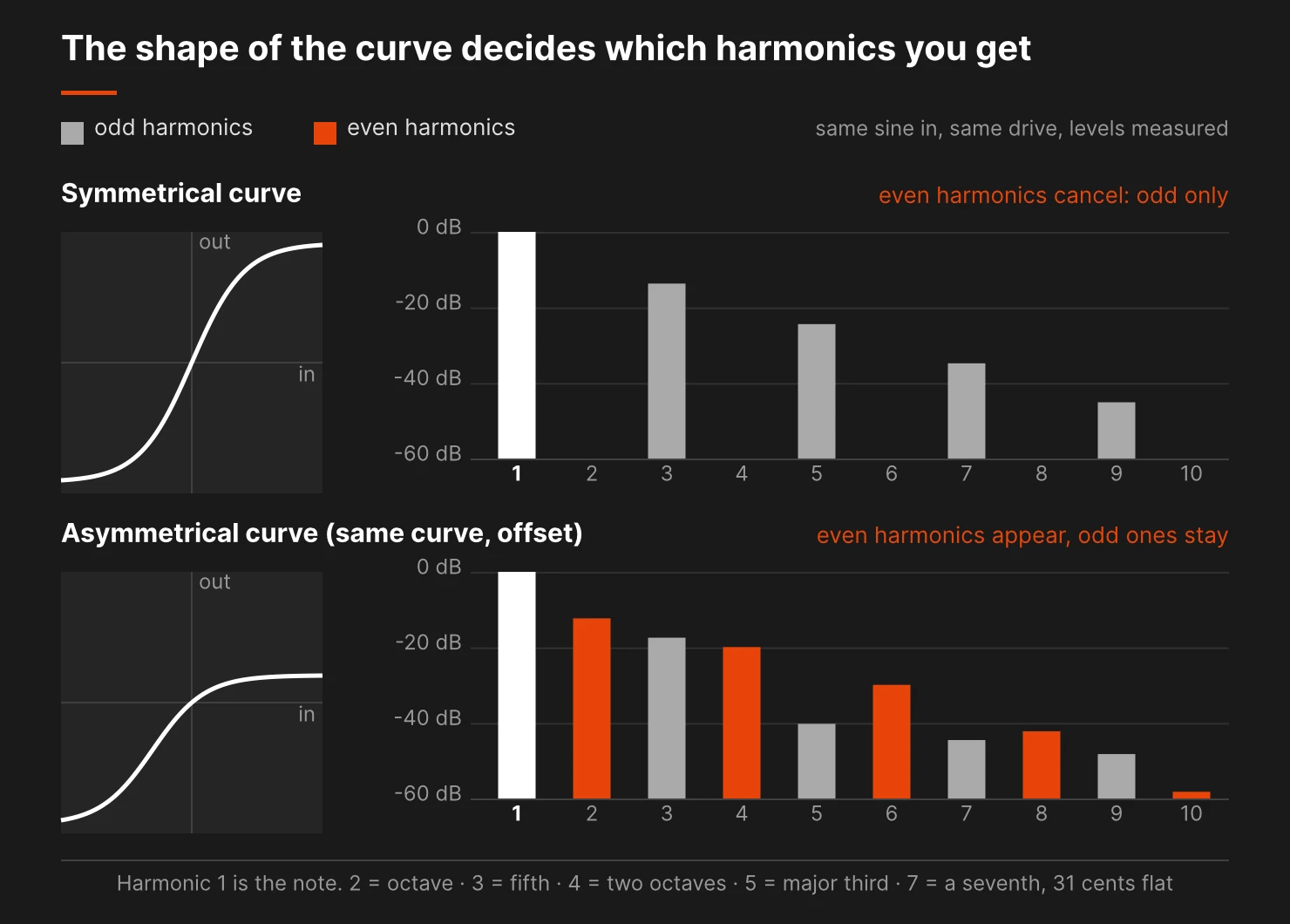
Now the tubes. Randall Aiken, writing about amplifier topology, is precise about where the difference lives. In a push-pull stage, "even order harmonics and distortion products generated in the output stage are canceled out". A single-ended stage offers "no rejection of even order harmonics (a great advantage to guitar players!)". Take the parenthesis as his taste, which he is entitled to. The circuit fact is the part that matters here.
Push-pull and single-ended are topologies, not technologies. Rod Elliott describes the cancellation the same way: the second valve carries the same waveform shifted by half a cycle, and when the two are summed in the output transformer the even-order harmonics cancel while the odd ones stay exactly where they were. So:
- A push-pull tube power amp, which is most tube power amps ever built, is an odd-harmonic machine.
- A single-ended stage, tube or transistor, is an even-harmonic machine.
- A single triode preamp stage driven hard is asymmetrical, which is where the tube reputation comes from. That is a statement about one stage, not about glass.
The last piece of the myth to go is the idea that asymmetry buys you only the nice ones. Elliott is worth quoting directly here: the asymmetrical waveform "contains not only the supposedly 'nice' even-order harmonics and intermodulation products - it also contains all of the supposedly nasty odd-order ones as a bonus". Asymmetry adds even harmonics. It does not remove odd ones.
The part that breaks the whole framing
Everything above is true of one note. Play two and it stops being the main story.
A nonlinearity applied to a sum does not give you the sum of the two distortions. It gives you sums and differences of everything present. Elliott again: intermodulation distortion "is based on the mixture of the original frequencies, their harmonics, as well as sum and difference frequencies based on every frequency - originals plus distortion components".
Here is why that matters more than parity. The harmonics of one note all sit on intervals above it, because they are whole-number multiples of it. Sums and differences of two notes only do that when the two notes are in a simple ratio. Take an A at 110 Hz and the C above it at 130.8 Hz, an equal-tempered minor third. The difference is 20.8 Hz, down in the sub. The sum is 240.8 Hz, which falls between A♯ and B, about 44 cents flat of the B. Tempered intervals, stacked chords and anything inharmonic, like a cymbal, give you products that land between the keys. They are not warm, they are not harsh, they are simply not in the key.
The count grows fast, too. One tone gives you a handful of harmonics. Two tones give you harmonics plus a grid of sums and differences. A drum bus, a kick fundamental plus broadband cymbal noise, gives you a continuous smear of products between the two, and that is the high-end grit that appears the moment you put a saturator across the group instead of across the parts. The low-end mud turns out to have a different cause.
That is a subject of its own, and it now has its own article. For today, one practical rule falls out of it: judge a saturator on one note, understand it on one note, and then test it on the actual material. The two will not agree, and the disagreement is intermodulation, not a flaw in either test.
What to do with this at the desk
- Solo one long low note and drive it. An octave means second order. A hollow fifth means third order. A sour major third on top of a minor part means fifth order. You can name it by singing it, which is faster and more reliable than reading a spectrum.
- Match the harmonic to the part. Want a bass to survive on a laptop speaker: you want a fifth, so odd. Want a synth to sound bigger without moving the harmony: you want an octave, so even. This is a musical decision, and it has a right answer that changes from track to track.
- Watch the fifth harmonic on minor material. It is a major third. If your minor chords go sour when you push a saturator, this is why, and pulling the drive back is not the only fix. Changing the curve is often better.
- Treat "harsh" as a question about order, not parity. If it is harsh, you are reaching harmonic 7 and beyond. Either drive less, filter the input so there is less high content to multiply, or move the saturation to a band where the products land somewhere harmless.
- Check on the chord, not on the note. Whatever you concluded in step 1 will be partly overwritten by intermodulation. That is expected. Step 1 lets you predict the direction of the change, not its size.
Where this leaves the tools
Once parity stops being the frame, "which saturation should I use" becomes an answerable question, because you are choosing an interval and a reach rather than a mood.
That is the thinking behind what I build. Grit Blender has 12 saturation algorithms, and instead of picking one from a list you blend three of them at a time by dragging a point inside a triangle. Sound On Sound put it this way: "With 12 styles of blendable saturation and a GUI that gives you plenty of control, Grit Blender is an impressive debut plug-in from UB DSP." Different curves mean different harmonic mixes, so moving the point moves you through the intervals above rather than through a menu. The point of the gesture is that you hear the harmonic move instead of reading its name.
One control is worth singling out, because it acts exactly on the problem in the table. KEY TRACK moves the saturation crossover with the note being played, half an octave above it: the fundamental stays clean and everything above it takes the saturation. On a bass, that is the difference between adding harmonics to a note and smearing the note itself.
It follows incoming MIDI notes, so the plugin has to be receiving notes, which is its own small maze depending on your DAW. The article on routing MIDI into an audio effect covers it. One thing worth knowing before you decide it is broken: tracking pauses while the audio going through the plugin is below a threshold, deliberately, so that notes arriving on a silent track cannot make the filter click. Correct MIDI routing on a silent track looks like nothing happening. The manual has the routing and the algorithm reference.
Frequently asked questions
What is the difference between even and odd harmonics?
They are different musical intervals above the note you played. The second harmonic is an octave, the fourth is two octaves, the eighth is three, so the low even harmonics restate the note itself. The third is an octave plus a fifth and the fifth is two octaves plus a major third, so the low odd harmonics build a major triad on the fundamental. Both sound musical. The trouble starts at the seventh harmonic, a minor seventh about 31 cents flat of the tempered one.
Do even harmonics sound warm and odd harmonics sound harsh?
No. The third and fifth harmonics are odd, and they are a perfect fifth and a major third, which is the most consonant material there is. What people hear as harsh is high-order content of either parity landing on intervals that are not in the scale, mostly harmonics 7, 11 and 13, and sitting in the 2 to 5 kHz region where hearing is most sensitive.
What decides whether a distortion produces even or odd harmonics?
The symmetry of the transfer curve. A curve that treats the positive and negative halves of the signal as exact mirror images produces only odd harmonics. Any asymmetry produces even harmonics as well, along with a DC offset. That is why adding a DC bias before a symmetrical clipper is the standard way to dial in even-order content.
Do tubes produce even harmonics and transistors odd harmonics?
No. That is a claim about topology, not about components. A single-ended stage, tube or not, is asymmetrical and produces even harmonics. A push-pull stage, tube or not, cancels most even-order content because the two halves are driven half a cycle apart and recombined. Most tube power amps are push-pull, so most tube power amps are odd-harmonic machines.
Why does the seventh harmonic clash?
Because it is a minor seventh roughly 31 cents flat of the equal-tempered one, about a third of a semitone. On its own it is a sweet interval. Against the tempered seventh in your arrangement it is too far to fuse and too close to read as a separate note, so the two beat. Harmonics 11 and 13 are out of tune in the same way.
Why does a saturator that sounds great on a bass sound muddy on a full mix?
Because harmonics are what a nonlinearity does to a single tone. Feed it two tones and it also produces sums and differences of every frequency present, harmonics included. Unless the notes are in a simple ratio, those intermodulation products land between the keys. The more complex the input, the more of the output is intermodulation.
How do I hear the difference between second and third order harmonic distortion?
Play one long low note, no chord and no drums, and drive the saturation hard. Second order adds an octave, so the note gets bigger without changing key. Third order adds a fifth, so it goes hollow and reedy, a bit like an organ stop. Sing what you hear on top of the note and you will name the interval faster than any analyser.
Sources
- J. Donald Tillman, "Distortion: Odd vs. Even", for the symmetry rule and the cancellation of even harmonics in a symmetrical nonlinearity.
- Randall Aiken, Aiken Amplification, "What Do the Terms Push-Pull and Single-Ended Mean?", for even-order cancellation in push-pull output stages and its absence in single-ended ones.
- Rod Elliott, Elliott Sound Products, "Valves (Vacuum Tubes): Harmonic and Intermodulation Distortion", for the push-pull cancellation mechanism, for intermodulation built on every frequency present, and for asymmetrical clipping carrying odd-order content as well.
- Wikipedia, "Harmonic series (music)", for the interval of each harmonic and for the 7th, 11th and 13th being the ones most out of tune with equal temperament.
- Wikipedia, "Harmonic seventh", for the 7:4 ratio sitting about 31.2 cents below the equal-tempered minor seventh.
- Audiofanzine forum, "Harmoniques et saturation svp", February 2009, in French.
- Gearspace forum, "2. order and 3. order harmonic distortion".
- John Walden, "UB DSP Grit Blender", Sound On Sound, July 2026.
Joy to use, joy to hear.
Ben, UB DSP