
Someone on Gearspace spent more than a hundred hours on this. In their words: "Usually clipping kick with hats using regular saturation plug-ins causes a lot of harshness on hihats and overall muddiness." They had tried hundreds of parallel and multiband setups, different types of distortion, soft clipping. They never got close to the records they were chasing.
The replies: wrong forum, play the drums softer, and one good suggestion with no explanation of why it works. Nobody told them what was happening, so nothing they tried could have worked except by accident.
Last week I wrote about even and odd harmonics, and I said the whole framing falls apart the moment you feed a saturator more than one note at a time. I also said that part deserved its own article. This is it, and the drum bus is where it does the most damage.
A saturator on a bus is not saturating the parts
Put a saturator on a kick alone and it adds harmonics of the kick. Put it on a hi-hat alone and it adds harmonics of the hat. Put it on both at once and it does something else, something neither of those two tests predicts.
Here is the reason, and it is arithmetic rather than opinion. Any saturator is a curve: you give it a number, it gives you back a slightly different number. Write that curve out as a series of terms and the first few are the input itself, the input squared, the input cubed, and so on. The squared term is where the trouble starts.
Square a sum and you do not get the sum of the squares. You get a cross term:
(kick + hats)² = kick² + 2 × kick × hats + hats²
The first and third terms are the ordinary harmonics, the ones I wrote about last week. The middle term is a multiplication of one source by the other, and a multiplication in time is a frequency shift in the spectrum. That middle term is intermodulation, and it is not a side effect. In the hat band, it is the biggest distortion product there is, bigger than anything the hats do to themselves.
Where the new frequencies land, in numbers
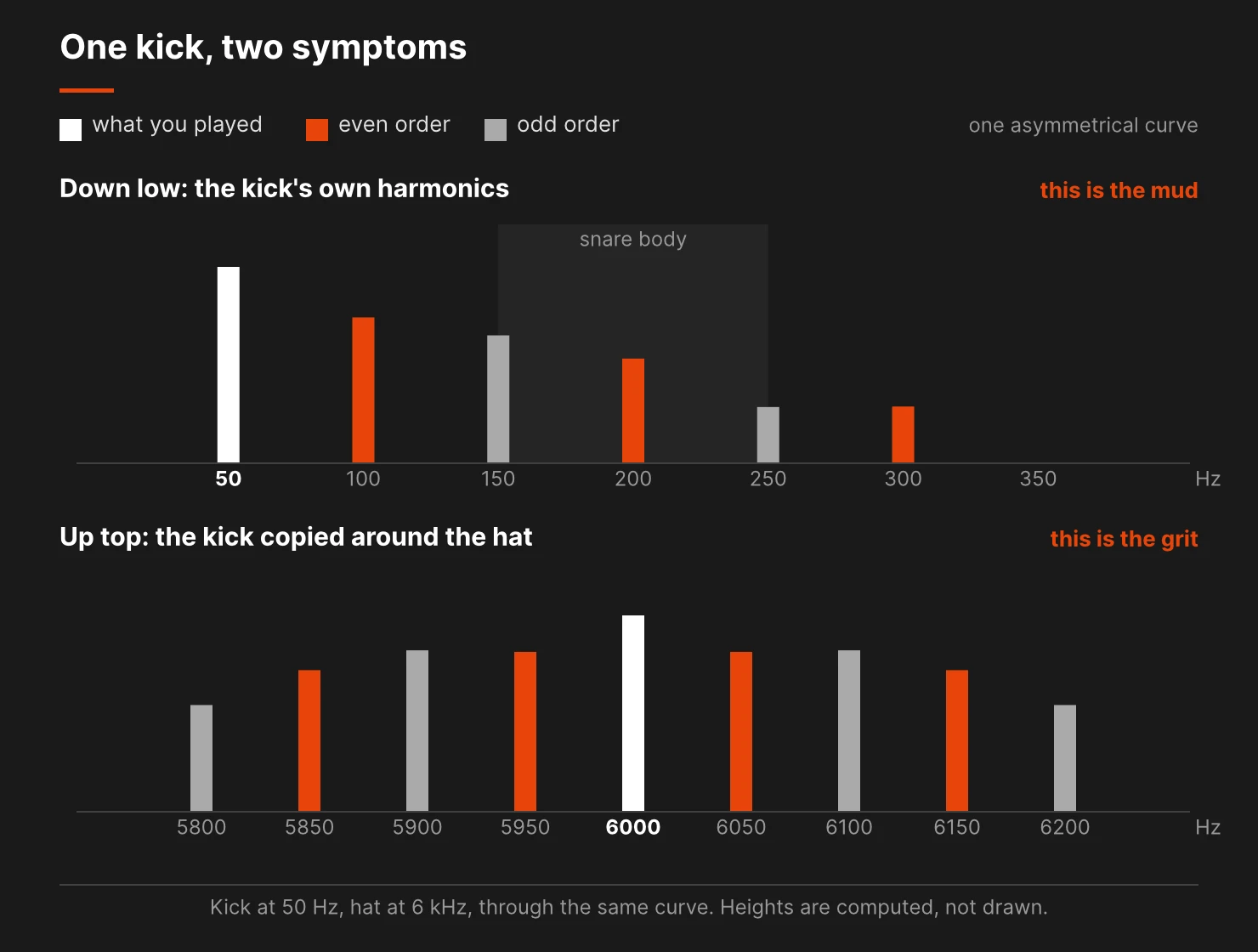
Take a kick with a 50 Hz fundamental and a hi-hat with energy at 6 kHz. Feed both into a curve with a squared term.
You get 6000 minus 50 and 6000 plus 50. So 5950 Hz and 6050 Hz. Two new components sitting either side of the hat, 50 Hz apart, that belong to neither instrument.
Now hold the hat still and play the kick. Those two components move with the kick's pitch, not the hat's. A tuned kick sliding from 50 Hz to 45 Hz drags them along with it. They are not harmonics of anything: no note in the session has 5950 Hz in its series. Your ear is good at noticing a frequency that is not part of any note being played, which is why a little intermodulation reads as grit while a lot more harmonic distortion gets called warmth.
That accounts for the hats. The mud has a different mechanism, and the same culprit.
Why the low end goes cloudy, and why it is mostly the kick
The mud is mostly the kick itself. Only a small part of it is intermodulation.
Feed a 50 Hz kick into a curve and it comes out with harmonics: 100, 150, 200, 250 Hz. On the kick alone, that is exactly what you wanted. It is what makes a kick read on a laptop speaker. On the bus, those frequencies land right on the snare body, the toms and the bass, in the octave where a mix goes cloudy first.
The curve also flattens the kick's peak more than its tail, so the tail comes up relative to the hit. The kick gets longer as well as thicker, and a longer kick covers more of everything else.
Intermodulation adds to that, and down here the partner is the snare, not the cymbals. A snare body around 200 Hz multiplied by a 50 Hz kick gives you 150 and 250 Hz: the same neighbourhood, at a lower level than the kick's own harmonics, following the kick's tuning as well as the snare's.
Last week I wrote that the mud and the grit both come from products between the kick and the cymbals. For the grit, that holds. For the mud, it does not, and the wrong version is tempting enough to deserve a sentence. Square a broadband sound and any two of its components 50 Hz apart give you 50 Hz, so in principle a curve can fold cymbals down into noise under the kick. The mechanism is real. Its size is not. When I simulated a kick, a snare and hats through three different curves, everything the cymbals contributed below 300 Hz, on their own or with the kick, came out far below what the kick produced there by itself. Cymbals are far quieter than the kick, and what they make down there scales with their level squared.
So the low end has the same culprit as the hats. Up top, the kick modulates the cymbals. Down low, it fills the low mids with its own harmonics. One instrument, two symptoms, which is good news: one decision fixes both.
Symmetry changes the spacing, not the problem
A symmetrical curve removes some of the products and keeps the rest, on both halves of the problem.
The squared term is the even order one, and even order terms only exist if the curve is asymmetrical, meaning it treats the positive and negative halves of the waveform differently. That is the same symmetry test I used last week to work out whether a saturator gives you octaves or fifths.
Make the curve perfectly symmetrical, which is what a plain hard clipper and a plain tanh soft clipper both are, and the squared term vanishes. So do the sum and difference products. Rod Elliott measured the difference frequency almost 75 dB lower in that case than from an asymmetrical circuit in the same test.
That does not get the cymbals out of trouble. The cubed term is odd, it survives, and it puts products at the hat frequency plus and minus twice the kick frequency. With the same 50 Hz kick and 6 kHz hat: 5900 and 6100 Hz instead of 5950 and 6050. The kick is still modulating the hats, with twice the spacing, and at a level that rises faster with drive than the even order products do.
It does not get the low end out of trouble either. A symmetrical curve still gives the kick harmonics, only the odd ones: 150 and 250 Hz, without the 100 and 200. Fifths and thirds without the octaves, in last week's terms, and all of them in the same low mids.
So "use a symmetrical clipper on the bus" is not the answer to either half. It changes where the products land, not whether they land.
The level that matters is not the one on the drive knob
The cross term is a product of both amplitudes. Kick times hats. That has a consequence you can use.
Turn the drive down and you reduce every term at once, harmonics included, which is why backing off the drive costs you the effect you wanted and only partly fixes the problem.
Take 6 dB off the kick going into the saturator, and you take at least 6 dB off every product that involves the kick, and you change nothing about the hats or their own harmonics. Same curve, same drive, same colour on the cymbals, half the sidebands or less. The kick's own harmonics fall faster still: at moderate drive, the second drops twice as fast as the kick and the third three times as fast.
That is the whole game. The loudest low frequency thing in the bus is the modulator, and the source of the mud. Everything else in the bus is what it modulates. You do not have to decide how much distortion you want. You have to decide what is allowed into the nonlinearity.
A test that takes ten seconds
Mute the kick. Loop the hats through the saturator. Listen.
Unmute the kick, and listen to the hats again, not to the kick.
If the hats changed character, that change is intermodulation. It cannot be anything else, because nothing about the hats' own signal path changed. This is the one listening test on this subject that cannot lie to you, and it also tells you how much of your problem is this and how much is something else, before you touch a single control.
For the low end, do it the other way round. Solo the kick, loop it, put an EQ after the saturator with a band soloed between 100 and 300 Hz, and switch the saturator on and off. What appears in that band is most of the mud you will have on the bus. It sounds great on the kick alone because nothing else lives there yet. Unmute the snare and the bass and it is sitting on top of them.
What to do at the desk
- Test on one element first. That is step one from last week's article and it still holds, with the addition that whatever you conclude from it will be partly overwritten when you put the bus back together.
- Split the bus. Kick and snare into one saturator, cymbals into another. This is what the one useful reply in that Gearspace thread suggested, and it works because the kick fundamental never meets the cymbal band inside a curve. It came with no reason attached, which is an uncomfortable way to receive a right answer, because you cannot adapt an answer you cannot explain.
- Or keep the lows out of the curve. If you want one instance on the bus, the useful control is a crossover that bypasses the saturation below a frequency, set above the kick's fundamental and its first partial. On a 50 Hz kick that means somewhere around 100 to 120 Hz. The kick's fundamental barely reaches the curve, so it modulates the hats far less and piles far fewer harmonics into the low mids. The price is that the kick also loses the harmonics you may have wanted on it. If those were the point, turn the kick down going in rather than filtering it out.
- Consider keeping the top out too. If what you wanted from the saturator was body on the kick and snare, letting the cymbals bypass it leaves the kick nothing up there to multiply.
- Do not expect a parallel send to solve it. Mixing the saturated signal underneath the dry one lowers the level of the products, in exactly the same proportion as the level of the effect you wanted. It does not remove them. And no phase alignment tool can either: those frequencies do not exist in the dry signal, so there is nothing in the dry signal for them to be aligned against.
- Re-check by muting. After every change, run the mute test again. It is the only measurement here that needs no instruments.
Where this leaves the tools
Grit Blender's advanced panel has both crossovers: below the low handle and above the high handle, the signal bypasses saturation instead of being filtered out of it. That distinction matters here. Filtering after the curve removes the products and the material together. Bypassing means the kick barely reaches the curve, so most of the products are never created, and the low end arrives unprocessed rather than repaired. Not all of them: a crossover has a slope, and a little of the kick still gets in. Grit Blender already splits at 80 Hz by default and sends the band below it around the curve. On a drum bus, turn on LOW CROSSOVER and raise it to 100 to 120 Hz. The exact ranges and behaviour are in the Grit Blender manual, under Advanced Panel.
Two honest notes to go with that. Eight of the 12 algorithms in Grit Blender are asymmetrical, so on a kick they add its octaves as well as its fifths, where the symmetrical four add only the fifths and thirds. Both families put harmonics in the low mids, which is a reason to use the crossover, not a reason to avoid either family. And the MIX control is a phase aligned crossfade with the dry input, which means it behaves predictably, not that it can undo intermodulation. Nothing can, once it is there. The only control that works on intermodulation is what you allow through the curve in the first place.
None of this is specific to my plugin. Any saturator with a band bypass, or any bus split, gets you the same result. The mechanism is in the arithmetic, not in the brand.
Frequently asked questions
What is intermodulation distortion?
It is distortion that produces new frequencies from combinations of two or more input frequencies, rather than multiples of a single one. Harmonic distortion of a 100 Hz tone gives 200 Hz, 300 Hz, 400 Hz. Intermodulation of 100 Hz and 6000 Hz gives 5900 Hz and 6100 Hz, which belong to no note's harmonic series.
Why does saturation make my drum bus muddy?
Mostly because of the kick itself. A saturator adds harmonics to the kick's fundamental, and on a 50 Hz kick those land at 100, 150, 200 and 250 Hz, on top of the snare body and the bass. Products between the kick and the snare add to it at a lower level. The cymbals play almost no part: what a saturator makes out of them below 300 Hz is far quieter than what the kick adds there.
Why do my hi-hats get harsh when I saturate the drum bus?
Because the kick is modulating them. Every loud low frequency component in the bus copies the cymbal band up and down by its own frequency, at a level proportional to the product of the two. The result is a cluster of components close to the hats that are not harmonics of anything and move with the kick rather than with the hats.
Is it better to saturate the drum bus or each drum separately?
For colour without intermodulation, separately, or in groups that do not put loud low frequencies and broadband highs into the same curve. Bus saturation is not a mistake, it is a different effect: the glue people like on a drum bus partly is the intermodulation. Do it on purpose, and keep a version without it to compare.
Does a symmetrical clipper avoid intermodulation?
It avoids the sum and difference products. It does not avoid intermodulation. A symmetrical curve still has odd order terms, and those put products at the high frequency plus and minus twice the low one, so the cymbals still get modulated by the kick, just with wider spacing. It does not protect the low end either: it gives the kick its odd harmonics instead of all of them.
Does oversampling fix it?
No. Oversampling deals with aliasing, which is a different mechanism: distortion products landing above half the sample rate and folding back down. Intermodulation products between a kick and a hi-hat land in the audible band legitimately, at frequencies the arithmetic puts them at. There is nothing for oversampling to prevent.
How do I hear intermodulation on a drum bus?
Loop the cymbals alone through the saturator, then unmute the kick and listen to the cymbals, not the kick. Any change in the cymbals is intermodulation, because nothing in their own path changed.
Does a parallel send fix it?
It lowers the level of the products and the level of the effect by the same amount. It does not remove them, and no phase alignment plugin can, because the products do not exist in the dry signal.
Sources
- Gearspace forum, "Drum bus saturation", January 2023, the question that started this.
- Rod Elliott, Elliott Sound Products, "Intermodulation - Something 'New' To Ponder", 2012, updated November 2023, on the role of symmetry in sum and difference products.
- Keysight, "What Is Intermodulation Distortion", for the general definition and the standard two tone test.
- Previous article in this series, on the harmonics half of the subject: Even and Odd Harmonics Are Not Warm and Harsh, They Are Intervals.
If you want the crossovers described above in a saturator that also lets you blend three of its twelve curves on a triangle, Grit Blender has a free trial with no time limit.
Joy to use, joy to hear.
Ben, UB DSP