
This question keeps coming back on production forums, and it never quite gets answered. Here's how one producer put it on the Ableton forum in 2018, passing on something he had been told: saturation can make an 808 "sound like it hitting hard on the low end when its really not".
Twelve replies follow. Some are useful. Nobody measures anything, and the original poster ends up agreeing he had overdone it.
The answer is yes and no, and the interesting part is which half is which. Saturation adds very little to your 808's low end. What it does is put energy where a small speaker can actually move air, and your ear reads that energy as the note you can no longer hear.
Your ear isn't fooling you. But the effect has a cost, and the cost lands on exactly the systems where you thought you were safe.
Two definitions first, because the question mixes them up
Level is what a meter reads. It's measurable, it's the same for everyone, and it doesn't care about your speakers.
Loudness, and audibility are what you hear. They depend on your speakers, the room, the other instruments playing, and how your ear assembles a pitch out of what reaches it.
"Does it hit harder" is a question about the second one, asked in the language of the first. That's why it's so hard to answer.
What a saturation curve actually does to a 50 Hz note
I simulated it rather than guessing. A 50 Hz sine at -6 dBFS, through a generic asymmetric soft clipping curve, then brought back to the same peak as the input. That's what the limiter on your master does anyway: it holds the peaks where they are.
Two things happen.
New partials appear above the note, never below it. They land at whole multiples of the note: 100 Hz, 150 Hz, 200 Hz. At moderate drive the first ones sit roughly 20 to 30 dB under the note, and the rest fall away from there. Push the drive and the strongest of them climb to within about 10 dB of it. The exact figures depend on the curve, which is why I'm giving orders of magnitude rather than a table: another curve gives other numbers, but the same shape.
The fundamental barely moves. In my runs it stayed within about 2 dB of where it started, up with some curves and down with others. And it can't go up by much more than that. At the same peak, no waveform can carry more fundamental than a square wave, and a square wave carries 2.1 dB more than the sine you started with. That's maths, so it holds for any curve.
So under a limiter, clipping an 808 can buy you about 2 dB of fundamental, and no more. That's real, and it's one reason people clip their 808s. But it's a couple of dB, nowhere near the change you hear when you play the same 808 on a phone.
Why it works anyway, on the speakers most people use
Now put that signal through a laptop speaker, a phone, a car dash.
None of them reproduce 50 Hz. Not quietly, not at all. Below its resonance, a small driver is a piece of plastic making excursion noise. The dry 808 arrives at that speaker with all of its energy at a frequency the speaker can't turn into sound.
The saturated one arrives with the same fundamental, which still doesn't come out, plus a row of harmonics above it. The ones that land inside the speaker's range do come out.
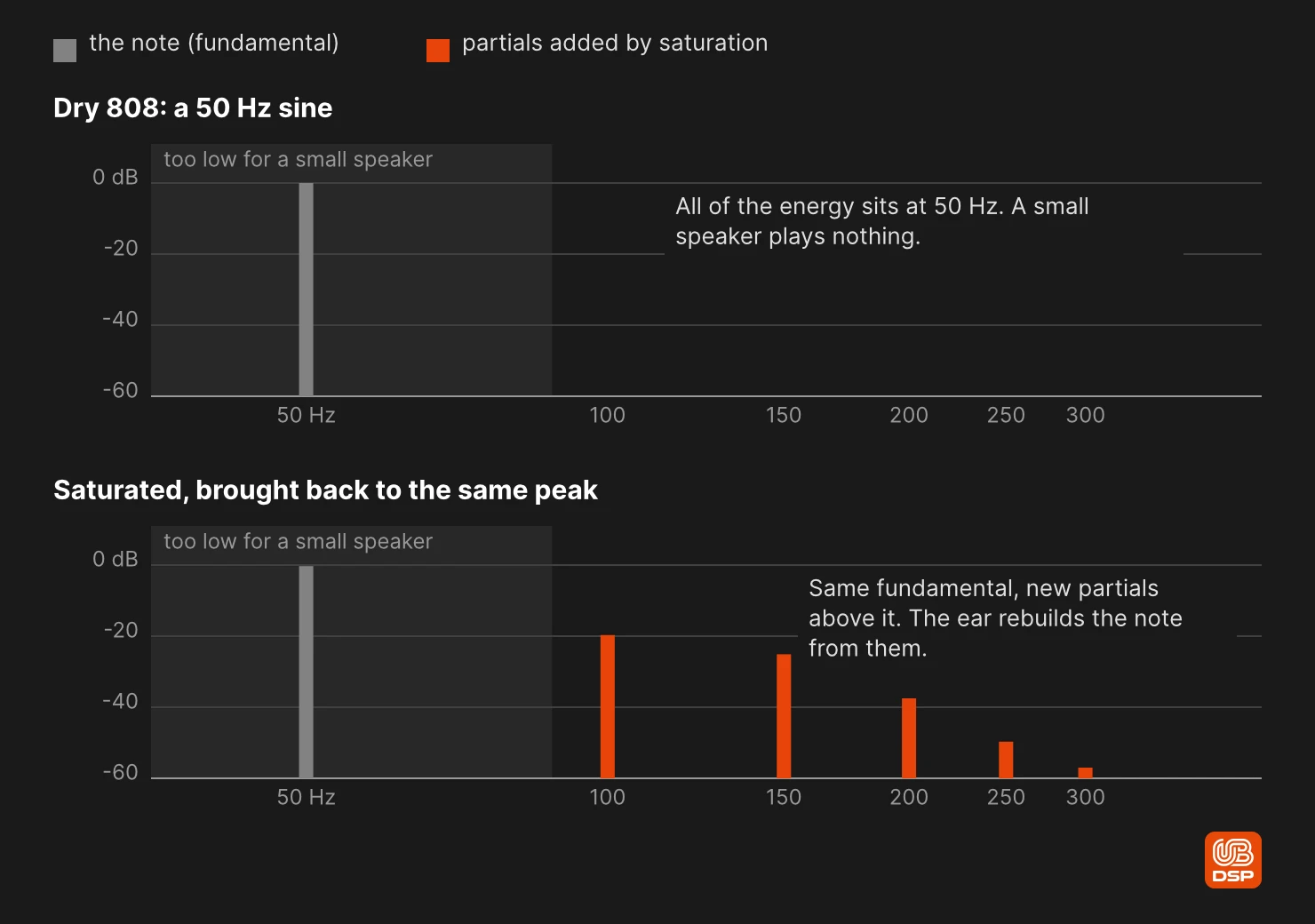
And your ear rebuilds the note from those harmonics. Doghouse got there further down the thread, describing a hardware bass enhancer: "our ears hear the additional harmonics as if there is also more fundamental". Play the harmonics of a 50 Hz tone with no 50 Hz at all, and the pitch you hear is 50 Hz. The literature calls it the missing fundamental, virtual pitch or residue pitch. Course notes from the University of Washington put it plainly: "if you present the harmonics alone, you still hear the pitch of the fundamental." They also rule out the obvious objection, that your own ear is distorting and recreating the tone: "masking the frequency of the fundamental doesn't affect the pitch."
Whole families of consumer audio products are designed around this. Aarts, Larsen and Schobben, at Philips Research, built a bass enhancement system on it. The bass goes through a nonlinearity that generates its harmonics, a filter keeps only those harmonics, and they're added to a high-passed copy of the signal, so the little speaker stops trying to play what it can't. Their words for the result: "These will still have the same perceived pitch of the original." In their listening test, with fifteen subjects, both harmonic versions were rated significantly higher than the unprocessed audio. So was a plain bass boost, to be fair, and preferences varied a lot from one listener to the next.
Your saturator is doing the first half of that system by accident.
The cost, and where it lands
Jlgrimes got to the trade-off before anyone else in the thread. Saturation, he wrote, "can make your base sound louder (or more audible on weak systems)". Then the catch: "you can overdo it and make bass wimpy".
He's right, and it's worth spelling out why.
Keep driving and the harmonics keep growing while the fundamental barely moves. Push far enough and the 100 Hz and 150 Hz content is no longer 20 dB under the note, it's within 10 dB of it. On the phone, fine, that's all you were ever going to hear. On a system that does reproduce 50 Hz, the balance tips. Your ear is far less sensitive at 50 Hz than at 150 Hz, so partials 10 dB down can sound as loud as the note, or louder. The sub is still there on the meter. The 808 just reads as the buzz above it, and the weight goes.
That's the shape of the problem: the setting that wins on a phone can lose on a club system, and you won't hear the loss on the phone. Check the big system, or at least a pair of headphones that go low, before you commit.
There's a second cost, and it only shows up once the 808 is in a mix rather than soloed. A nonlinearity doesn't process your sources separately, it processes their sum, so it generates products between them. On a drum bus that's where the mud comes from, and it's the kick's own harmonics plus the kick times snare product doing it, not the cymbals. I worked through that one separately. An 808 is the loudest thing going into any bus it shares, so it's the one setting the terms.
Which curve you pick decides which note you get back
This one decides whether the trick works on your particular speaker, and almost nobody mentions it.
Harmonics are intervals. The 2nd harmonic is the octave above the note. The 3rd is an octave and a fifth. The 4th is two octaves. I've written this up at length, and it matters here for a practical reason.
A curve that treats the positive and negative halves of the waveform differently produces even harmonics as well as odd ones, so a 50 Hz note gets a partial at 100 Hz, its octave. A curve that treats both halves the same produces only odd harmonics, so there's nothing at 100 Hz. In the simulation the symmetric curve put nothing at 100 Hz at all, as the maths says it must, and its first new partial landed at 150 Hz, the twelfth.
Why you care: 100 Hz and 150 Hz aren't the same bet. A small speaker loses output fast below the lowest note it can play, so half an octave can decide whether your first new partial gets heard at all. And if your target plays 100 Hz fine, you don't need to jump to the twelfth, a more conspicuous interval that sits on top of your bassline in a way the octave doesn't.
So the practical rule is to pick the curve whose first new partial lands where your target speaker starts working, and stop there. More saturation won't fix the wrong curve.
Try both on the same 808 and switch between your monitors and your phone. One of them will be obviously right, and which one depends on your 808's tuning as much as on the speaker.
How to actually do it
Four things, in order of how much difference they make.
Distort the note, then take the low end out of the distorted part. The harmonics are made from the fundamental, so the fundamental has to go into the curve. What it doesn't need is to come back out of it in place of your clean sub. Run the 808, or a copy of it, through the saturator, high-pass the saturator's output somewhere around 80 to 120 Hz, and blend that over the untouched 808. It's the Philips layout from above: the bass goes into the nonlinearity, and a filter after it keeps only the harmonics.
Some saturators split the signal for you, the other way round, and it's worth knowing what that does to an 808. In Grit Blender the low band always bypasses saturation, under a 24 dB/oct split. By default it sits at 80 Hz, so a 50 Hz note still reaches the curve, just quieter. You can move it. LOW CROSSOVER goes down to 40 Hz, where most of the note goes through. KEY TRACK keeps the split half an octave above the note you send it over MIDI, so the fundamental reaches the curve about 14 dB down and stays clean. The manual has the detail.
Use the mix control instead of backing off the drive. Oratowsky had the right instinct: "extreme distortion (gain/drive high) and then mixed in only like 30-40% wet."
Hard drive gives you a rich set of partials. A partial wet mix keeps the fundamental's share of the total where it belongs. You get the audibility without the wimpiness. Blending a distorted copy back in and sweeping the balance is usually faster than hunting for the one drive setting that works.
Match loudness before you judge. Most saturators make things louder, and louder always sounds better for the first ten seconds. Matching peaks isn't enough: saturation shaves the peaks, so at the same peak the saturated version is still a couple of dB louder on average. Match by loudness instead, with a LUFS meter or by ear (some saturators have a switch that does it for you), then A/B. A good part of the "it hits harder" impression goes away at this step. What's left is the real difference.
Check it on the worst speaker you own, and the best, in that order. The worst one tells you whether the trick worked. The best one tells you what it cost.
When you get it right, you'll know. The 808 comes through the phone in your pocket, and it still moves the room when the big speakers come on.
Frequently asked questions
Does saturation add low end?
Hardly. It adds content above the note, at whole multiples of it. In a simulation of a 50 Hz note brought back to the same peak, the fundamental moved by about 2 dB at most, and no curve can raise it by more than 2.1 dB at the same peak. Partials appeared at 100 Hz, 150 Hz and up, the first ones roughly 20 to 30 dB under the note at moderate drive. Nothing is added below the note.
Then why does my 808 sound bigger on my phone after saturating it?
Because your phone can't reproduce 50 Hz, but it can play some of the harmonics above it, and your ear rebuilds the 50 Hz pitch from them. It's called the missing fundamental, or virtual pitch. Commercial bass enhancement systems are built on the same principle.
Can saturation make my bass weaker?
Yes, on systems that do go low. Drive far enough and the added harmonics come within about 10 dB of the fundamental. Your ear is much less sensitive at 50 Hz than at 150 Hz, so they take over the sound: the sub is still on the meter, but the 808 reads as the buzz above it. That's why the setting that sounds best on a laptop can sound thin in a club.
Should I use an even harmonic or an odd harmonic saturator on an 808?
It decides where your lowest added partial lands. An asymmetric curve gives you the octave, 100 Hz for a 50 Hz note. A symmetric one skips the octave and starts at the twelfth, 150 Hz. Pick the one whose first partial falls inside the range your target playback system actually reproduces, and try both, because it depends on how your 808 is tuned.
Sources
- The thread this article answers: dusty4444 and others, "Saturation -Does it add power or does it sound like it does", Ableton forum, 19 August 2018 to 10 January 2019, 13 posts. Quotes from dusty4444, doghouse, jlgrimes and oratowsky.
- R. M. Aarts, E. Larsen and D. Schobben, "Improving Perceived Bass and Reconstruction of High Frequencies for Band Limited Signals", Proceedings of the IEEE Benelux Workshop on Model-based Processing and Coding of Audio (MPCA-2002), Leuven, 15 November 2002, for the system layout, the quote and the listening test.
- Pitch perception course notes, SPHSC 461, University of Washington, citing Yost (1994), Gelfand (1998) and Moore (1997), for the missing fundamental.
- Partial levels and the fundamental's ceiling: numerical simulation of generic saturation curves on a synthetic 50 Hz sine, run for this article. Not a measurement of any plugin. The 2.1 dB ceiling is the fundamental of a square wave at the same peak, 4/π times the sine's.
- UB DSP, Drum Bus Saturation: Why the Low End Goes Muddy and the Hats Go Harsh, and Even vs Odd Harmonics: What Each One Actually Adds to Your Sound.
- The Grit Blender manual, Advanced Panel, for the low split.
Joy to use, joy to hear.
Ben, UB DSP