
In 2021 someone on Gearspace asked how to make slight shifts to the vowels in a vocal. He got a useful answer in the very first reply: try Melodyne. He also got six people asking, at length and in good faith, what "shifting vowels" was even supposed to mean. One of them just wrote "formants?" and left it at that.
The question was clear. The vocabulary was not. That is the whole problem, and it has not aged a day.
"Changing the vowels" can mean three completely different operations.
- Pitch shift moves the note.
- Formant shift moves the apparent size of the person singing.
- Vowel morph moves the vowel itself.
Three operations, three kinds of tool, three failure modes. Once you have the word, the tool is obvious. Most of the confusion online is people answering a different one of the three than the one that was asked.
One more detail from that thread, because it comes back at the end. Before anyone replied, the man asking had already written off the obvious approach. EQ, he said, always made things sound imbalanced when he tried it. He was reaching for the right tool. He was using it in a way that cannot work, and nobody in the thread told him why.
If you have not read the source-filter piece, it is the background for all of this. The short version: a voice is a source (the buzz of the vocal folds, which sets the pitch) going through a filter (the throat and mouth, which sets the vowel), and the two are largely independent.
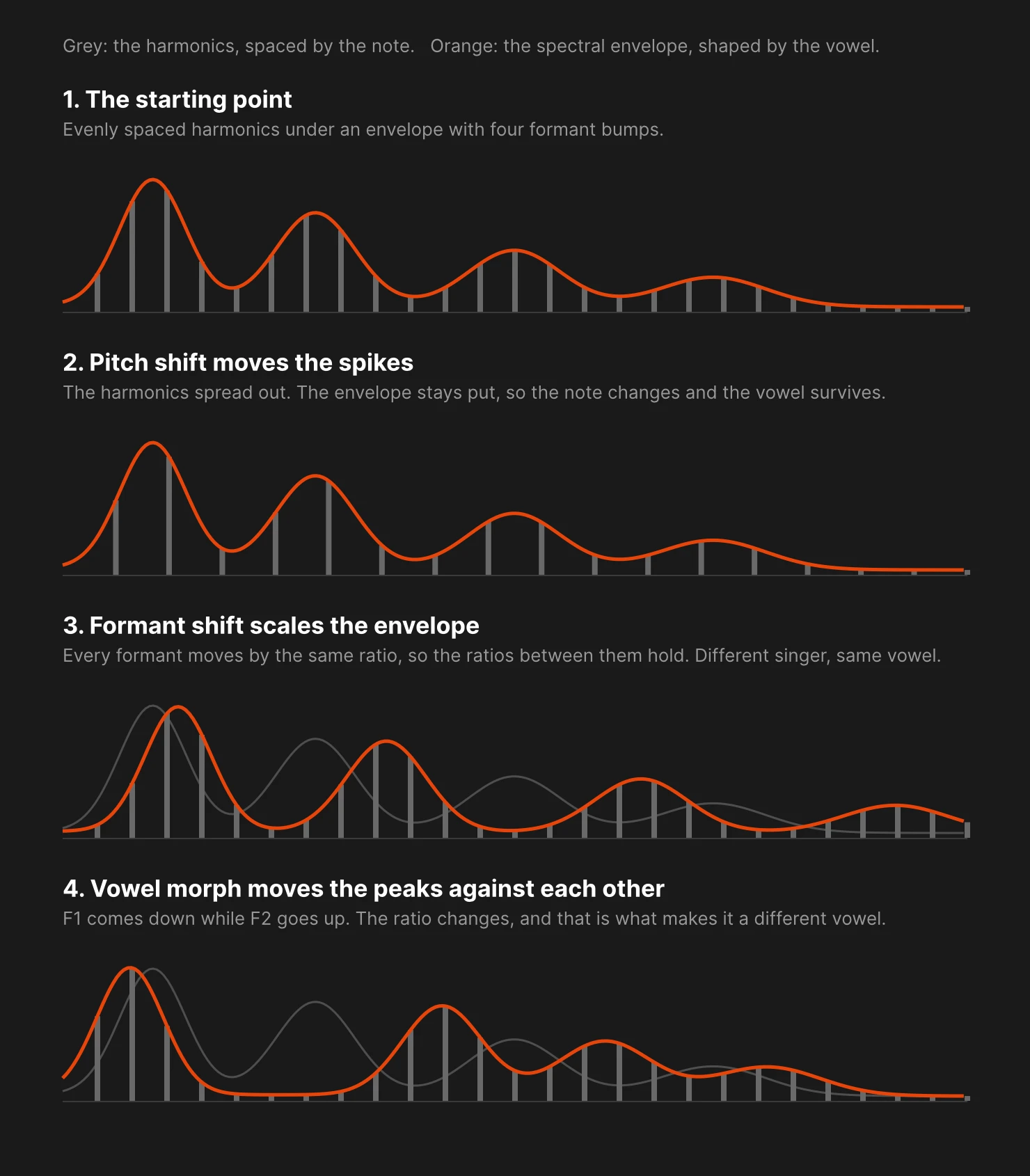
One picture, two layers
Open a spectrum analyser on a sung note and you are looking at two things stacked on top of each other.
The first is a set of evenly spaced spikes: the fundamental and its harmonics. Their spacing is the note. Sing an octave up and the spikes spread out to twice the spacing.
The second is the shape draped over the tops of those spikes. That is the spectral envelope, and its bumps are the formants. The envelope is made by the resonances of your vocal tract, so it belongs to the shape of your head, not to the note you are singing.
Every one of the three operations is a different way of moving one of those two layers.
Operation 1: pitch shift
Pitch shift moves the spikes. That is the whole job.
The catch is what happens to the envelope while you do it. If you just play the file faster, or resample it, everything scales together. Stephan Bernsee, who wrote a lot of the reference material on this, puts it plainly: altering the sample rate expands "the fundamental frequency along with all harmonics and the spectral envelope to the right, i.e. to higher frequencies". The result, in his words, "has the same effect as altering the proportions of the vocal tract of the singer, shrinking or stretching him or her in size from a dwarf to a monster."
That is the chipmunk sound. It is not a pitch problem. The pitch is exactly where you asked for it. The problem is that you also made the singer's head smaller.
So every serious pitch shifter now gives you a way to hold the envelope still while the spikes move. In Ableton, that is the Formants control in Complex Pro: the manual says that "at 100%, the original formants will be preserved, even if the pitch is changed significantly."
What pitch shift cannot do: change which vowel you hear. Move everything by the same ratio and "ah" stays "ah".
Operation 2: formant shift
Formant shift is the mirror image. The spikes stay put, the envelope moves.
Celemony's description of the Formant tool in Melodyne is the clean definition: formants are "areas of emphasis or attenuation in the frequency spectrum of a sound that are independent of the pitch of the fundamental note but are found always in the same frequency ranges." Move them, and the note does not move.
What you hear when you do this is not a vowel change. It is a size change. Antares put it in one line: "Pitch shifting moves the note. Formant shifting moves the voice", which they gloss as the timbral character that makes a soprano sound like a soprano and a baritone sound like a baritone.
Here is the part that almost nobody explains, and it is the reason this operation behaves the way it does.
A formant shift is a uniform scaling. Every formant moves by the same ratio. F1, F2 and F3 all go up 8 percent together. That keeps the ratios between them intact, and vowel identity lives in those ratios, not in the absolute frequencies. A child and an adult man saying "ah" have wildly different absolute formant frequencies, and you hear the same vowel from both, because your ear normalises for vocal tract length. That normalisation is a well studied effect in speech perception, and it is exactly what a formant shifter is exploiting.
So a uniform scale changes the speaker and keeps the vowel. This is why the control is often labelled with genders or with a size metaphor rather than with a number.
In Vowel Blender this operation is a knob called SHIFT, calibrated in semitones from minus twelve to plus twelve, and under the hood it is exactly the multiplication described above: all four formants scaled by the same ratio. Semitones rather than a percentage because the ear hears frequency ratios, so the same number of semitones sounds like the same amount of move wherever you apply it.
It is also why it goes wrong fast. One semitone of formant shift is already a clear change in character. Antares suggest starting between 0.3 and 0.7 of a semitone for doubling and subtle character work, which matches what I hear. Past three or four semitones, in my experience, it stops reading as a different person and starts reading as an effect, which is a legitimate thing to want.
In Bitwig the control is worth looking at closely, because it exposes the machinery instead of hiding it. On an audio clip, Formant gives you two things: a toggle that shifts formants automatically to follow the pitch expression, and a numeric control for a fixed shift in semitones. There is also a Resolution parameter, which the user guide describes as setting "the relative size of the spectral envelope used for formant shifting."
That last one is the interesting one. Before a tool can move the envelope, it has to decide which part of the spectrum is envelope and which part is harmonics. Resolution is where you tell it. Set it wrong and it starts treating individual harmonics as formants, which on a high, sparse voice is a very easy mistake to make. If your formant shift sounds gritty or hollow on one singer and fine on another, that is usually the first thing to move.
What formant shift cannot do: turn "ah" into "ee". Uniform scaling preserves the ratios, and the ratios are the vowel.
Operation 3: vowel morph
This is the one the original question was actually about, and the one almost nobody has a knob for.
To change a vowel you have to move the formants relative to each other. F1 tracks how open your mouth is. F2 tracks how far forward your tongue sits. Move F1 up while F2 stays, and you have not made a bigger singer, you have made a different vowel. That is why vowel charts are drawn as a plane rather than as a list.
There are two ways to get there, and they are not the same job.
Impose the formants. A formant filter or a vowel filter has a set of resonances built in and applies them to whatever comes through. It does not care what was there before. This is cheap, stable, and it works on anything: a pad, a bass, a drum loop. It is also, strictly, not a modification of the source vowel. It is a new vowel painted over it.
Analyse and redraw. Estimate the spectral envelope of the incoming voice, move individual peaks around, resynthesise. This is what you would need to genuinely nudge the vowel of a real take while keeping the singer. It is a much harder problem, and the hard part is the estimate, not the moving.
Why the estimate is hard: the only evidence you have about the envelope is where the harmonics poked through it. On a low note the harmonics are closely spaced, so you get many samples of the curve and a good fit. On a high note they are far apart, and a formant sitting between two harmonics leaves almost no trace. The tool then guesses, and the guess is what you hear as smearing, warble or a hollow spot.
This is the same mechanism that makes high sung vowels genuinely harder to identify by ear. The information is thin, for you and for the algorithm.
So what should you actually do
Start from what you want to hear, not from what the knob is called.
| What you want | Operation | What moves | Typical tool |
|---|---|---|---|
| Same singer, different note | Pitch shift with formant preservation on | Harmonics only | Melodyne, Complex Pro, Bitwig stretch modes |
| Same note, bigger or smaller singer | Formant shift | Envelope only, uniformly | Melodyne Formant tool, Bitwig Formant, any two knob vocal shifter |
| Chipmunk or monster on purpose | Pitch shift with formant preservation off | Both together | Varispeed, tape, resampling |
| Different vowel, same singer | Vowel morph | Formants relative to each other | EQ for small moves, formant filter or resynthesis for large ones |
| A vowel on something that never had one | Impose formants | Nothing, they are added | Formant filter, vowel filter, vocoder |
Which brings us back to the man who said EQ always sounded imbalanced.
He had the right tool. For slight shifts to vowels in a real vocal, EQ is the answer, but only as two moves, not one.
The instinct is to boost the region where the vowel seems to live. That does not change the vowel, it changes the tone, and on a real track it sounds like exactly what it is: a boost. Vowel identity is a ratio, so you have to move F1 and F2 in opposite directions. Push one up and pull the other down, a couple of dB each, narrow bells. F1 sits roughly between 250 and 700 Hz for an adult voice, F2 roughly between 600 and 1900 Hz. Both regions sit higher for women and children, whose vocal tracts are shorter.
One bell is a tone control. Two bells moving against each other is a vowel control. That is the whole difference between "imbalanced" and "slightly different vowel", and it costs nothing, because you are not asking any algorithm to guess anything. It will not carry a large move. For a small one it beats every fancier option.
Sweep a narrow boost slowly through 250 to 900 Hz on a sustained vowel and you will hear the vowel change under your hand. That five second experiment teaches the whole idea better than this article does.
Where this leaves the tools
Once you have the three words, plugin descriptions start reading differently.
A plugin with a Pitch knob and a Formant knob is doing operations 1 and 2. There is usually no third knob, because the third operation is a different kind of problem.
Vowel Blender sits on the imposing side of operation 3. It never analyses the formants that arrive, it applies the ones you point at: 10 vowels, 4 formants and 7 voice models, and instead of typing frequencies you move through the vowel space as a single gesture. That makes it useful on the material where operation 3 is otherwise unavailable, which is everything that is not a voice. The manual has the routing details, and the product page has audio.
Next in this series: why a more expensive vocoder will not make your words any clearer. It turns out to be a consonant problem, not a band count problem.
Frequently asked questions
What is the difference between pitch shifting and formant shifting?
Pitch shifting moves the fundamental and all its harmonics, so it changes the note. Formant shifting moves the spectral envelope draped over those harmonics, so it changes the apparent size of the singer and leaves the note alone. Most modern vocal tools give you a separate control for each.
Does formant shifting change the pitch?
No. Formants are regions of emphasis in the spectrum that are independent of the fundamental. Moving them changes timbre and apparent vocal tract size, not the note.
Why does a pitched up vocal sound like a chipmunk?
Because a naive shift stretches everything, harmonics and envelope together, and moving the envelope up is the same as shrinking the singer. Turn on formant preservation and the effect disappears.
How do I change the vowel sound in a recorded vocal?
Move the first two formants relative to each other, not together. For small moves, a narrow EQ bell in the F1 region and another in the F2 region, pushed in opposite directions, will do it with no resynthesis. For large moves you need a tool that estimates and redraws the envelope, and that estimate is what breaks first on high notes.
Is a formant shifter the same as a vowel filter?
No. A shifter scales the formants already in the signal, all by the same ratio, so it changes the speaker and keeps the vowel. A filter imposes resonances you choose, so it changes the vowel.
How much formant shift is too much?
One semitone is already clearly audible. Antares suggest 0.3 to 0.7 of a semitone for subtle character work. Past three or four semitones it stops sounding like a different person and starts sounding like an effect, which is sometimes the point.
Why does formant shifting sound worse on some singers than others?
Usually because of the envelope estimate rather than the shift itself. High voices have widely spaced harmonics, which gives the analysis less to work with. If your tool exposes a resolution or envelope size control, that is the one to move first.
Sources
- CoolDude and others, "What's the pro method for shifting vowels?", Gearspace, January 2021, for the question and the vocabulary problem around it.
- Stephan Bernsee, "On the Importance of Formants in Pitch Shifting", for the spectral envelope and what naive shifting does to it.
- Celemony, Melodyne 5 documentation, Formant Tool, for the definition of formants as independent of the fundamental.
- Ableton, Reference Manual, Audio Clips, Tempo and Warping, for the Complex Pro Formants control.
- Bitwig, Studio user guide, Inspecting Audio Clips, for the Formant and Resolution controls.
- Antares, "What Is Formant Shifting", for the production framing and typical amounts.
- Gordon E. Peterson and Harold L. Barney, "Control Methods Used in a Study of the Vowels", Journal of the Acoustical Society of America, 1952, for the vowel plane and the spread of formant values across speakers. Dataset as summarised in the Praat documentation.
- Csound, Formant Values, for the formant frequency ranges quoted for adult voices.
Joy to use, joy to hear.
Ben, UB DSP