
Turn on swing on almost any drum machine and the thing that moves is not the note you expected.
You learned swing as long-short eighth notes, the ding, da-ding of a ride cymbal. You turn the knob, the eighths stay put, and the little notes in between start to limp. That is the whole complaint of a 2019 thread on Elektronauts, where the poster admits it makes them reluctant to use swing: "gee I want that classic swing feel but this ain't gonna cut it."
The thread gets the facts right in pieces. Someone quotes the Monomachine manual, someone links Roger Linn, a Digitakt owner gives a workaround. What it never puts together is why the 16th, and why the number on the knob is only half the answer. Both have short explanations.
What the swing percentage measures
Swing on a drum machine takes the notes of the grid two by two and decides how the time is shared inside each pair.
Roger Linn, who says he built swing into his LM-1 drum machine in 1979, counts it as the share of the pair that goes to the first note. At 50%, both notes get the same time. At 66%, the first note gets two thirds and the second one third, so the second note lands where a triplet would put it. Everything in between is a ratio, and the ratio is all the knob sets.
| Swing setting | Long : short | What it is |
|---|---|---|
| 50% | 1:1 | straight |
| 54% | 1.17:1 | Linn's setting to loosen a straight beat without it sounding swung |
| 62% | 1.63:1 | between straight and triplet |
| 66.7% | 2:1 | the triplet ("66%" in Linn's own wording) |
| 75% | 3:1 | dotted rhythm |
| 80% | 4:1 | the top of a Digitakt's SWING |
The Digitakt's SWING runs from 50% (the default, even) to 80%. Not every manufacturer counts this way, and that matters later.
Why the 16th
Linn applies swing to 16th notes. He delays every even-numbered 16th, the second note of each pair, and leaves the beat and the eighths where they are. The Monomachine manual describes the same thing: every second 16th, starting on step 2. Linn explains how, not why.
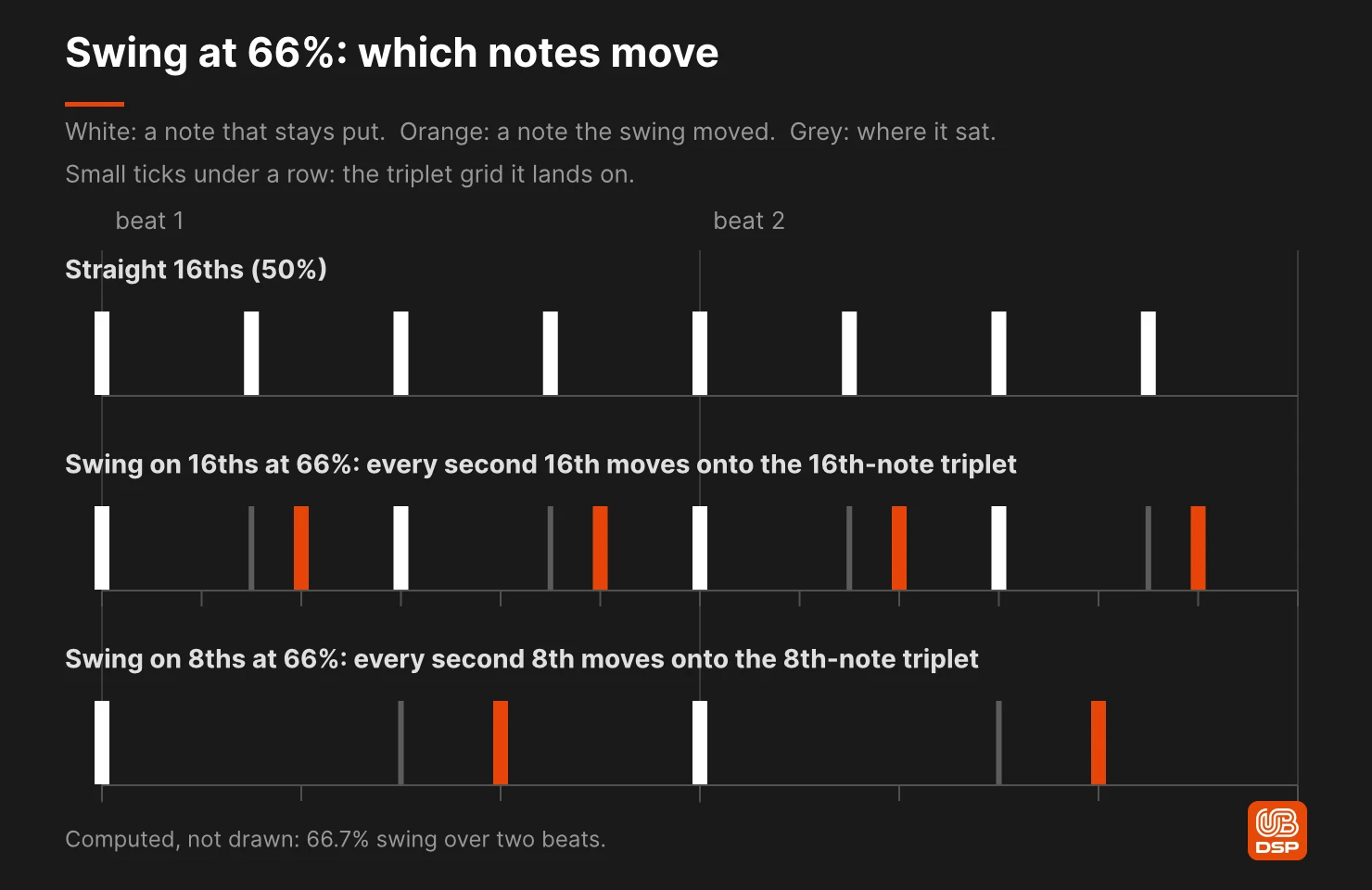
Here is how I read it. At 120 BPM, a pair of 16ths lasts 250 ms. A pair of swung eighths at 240 BPM, a fast jazz tempo, also lasts 250 ms.
So what the machine swings is a length of time, whatever the note is called. At 90 to 130 BPM, where a lot of drum machine music sits, the pair it swings is two 16ths. The eighth pair at those tempos is 460 to 670 ms long, which is where a jazz drummer swings when the band plays at a slow to medium tempo. One drummer in the thread gets very close to this: quarter notes at 120 BPM sound like half notes at 240.
The machine is doing what it was built to do. It assumes your song swings at the speed of its grid, and yours swings at half that speed.
The ratio a drummer plays changes with the tempo
The second half of the answer is the number. Linn calls 66% perfect triplet swing. Real drummers do not play it at every tempo.
Anders Friberg and Andreas Sundström measured the swing ratio jazz drummers play on the ride cymbal, on three well-known recordings and a play-along record (Music Perception, 2002). At slow tempos the ratio went as high as 3.5:1, which is 77.8% on a drum machine. At fast tempos it came down to 1:1, straight. The 2:1 triplet showed up only at a certain tempo. And from medium to fast tempos, the short note stayed at about 100 ms whatever the tempo.
That last point is the useful one. If the short note stays near 100 ms, the percentage that keeps it there falls as the tempo rises:
| Grid | Tempo | Pair length | Setting that keeps the short note at 100 ms |
|---|---|---|---|
| 8ths | 160 BPM | 375 ms | 73% |
| 8ths | 200 BPM | 300 ms | 67% |
| 8ths | 240 BPM | 250 ms | 60% |
| 16ths | 120 BPM | 250 ms | 60% |
| 16ths | 130 BPM | 231 ms | 57% |
My calculation, from the 100 ms in the paper's abstract: short note = pair length × (1 − setting).
Treat this as a starting point. The 100 ms comes from jazz ride cymbals at medium to fast tempos, and house hi-hats are another thing. Linn's own example even goes the other way: he finds a 90 BPM swing groove looser at 62% than at 66%, where the 100 ms estimate would say 70%. What the measurement does tell you is that there is no single right swing amount. 66% is one point on a curve, and the curve moves with your tempo.
The practical version: when a swung groove feels stiff at a fast tempo, try less swing before you try more. When it feels too straight at a slow tempo, go past 66%.
How to get eighth-note swing
Leave the amount alone and change the pair the machine swings.
In Bitwig Studio. The global groove is in the Play menu. Turn on Enable Groove, set the Shuffle Rate to 1/8 instead of 1/16, then set Shuffle. Bitwig counts on a different scale from Linn's: Shuffle is the distance, from 0% to 100%, that the even-numbered note moves toward the next smaller division. So 0% is straight, about 66.7% puts the off-beat eighth on the triplet, and 100% moves it a full 16th late (75% on Linn's scale). Clips only follow it when they ask for the global groove. A 66% typed in Bitwig and a 66% on an MPC are the same groove only at that one value.
On a Digitakt. The trick from the thread: set the pattern SCALE to 1/2X, so each step is an eighth note at the same BPM, then set SWING to 66%. The swing still moves every second step, which is now every second eighth. The cost is resolution. A 16-step page now lasts two bars, and the grid has no 16th steps left for hi-hat rolls.
On any machine that runs on its own clock. Halve the tempo and program the song's eighths as 16ths. The machine's 16th swing is now your eighth swing. It is the Digitakt trick again, done with the tempo instead of the scale.
In a plugin with no swing control. The Step Sequencer in Filter Blender and Vowel Blender has no swing, but its DIVISION button has a triplet submenu. Set DIVISION to 1/8T, and each step lasts a third of a beat. Set Steps to 3 (or 6, or 12) so the loop lines up with the beat, and keep the defaults of a new card: Forward, Flat steps, Smooth at 0. Give the first two steps of each group the same value and the third its own. The modulation now changes exactly on the swung eighth, 66.7%, and in Forward the steps follow your host's beat grid while the transport plays. With 1/16T and six steps per beat, the same pattern gives swung 16ths. The Step Sequencer card in the Filter Blender manual covers the steps, their shapes and Smooth.
When the swing finally sits where your head was hearing it, you stop fixing the groove and start playing over it.
Frequently asked questions
What swing percentage is a triplet feel?
66.7%, on the scale where 50% is straight. Machines usually label it 66%. In Bitwig's Shuffle, where 0% is straight, it is also about 66.7%, but the two scales part ways everywhere else.
Is 50% swing straight?
On a Linn-style scale, yes: both notes of the pair get the same time. On Bitwig's Shuffle, straight is 0%.
Does swing move the downbeats?
Not in Linn's implementation. Only the second note of each pair moves later. The beat and every first note stay on the grid.
What is the difference between swing and shuffle?
On drum machines, nothing fixed. As one member of the thread puts it, manufacturers use the two words interchangeably. What counts is in the manual: which note of the pair moves, and how the percentage is counted.
Why does my swing sound right at one tempo and wrong at another?
Because drummers do not keep the same ratio across tempos. Measured on jazz ride cymbals, the ratio falls as the tempo rises, from 3.5:1 at slow tempos to straight at fast ones. A fixed setting matches the player at one tempo only.
Sources
- Elektronauts, "Can someone explain to me why swing affects 16th notes?", January 2019, 28 posts.
- Roger Linn interviewed by Greg Scarth, "Roger Linn On Swing, Groove & The Magic Of The MPC's Timing", Attack Magazine, 2 July 2013.
- Anders Friberg and Andreas Sundström, "Swing Ratios and Ensemble Timing in Jazz Performance: Evidence for a Common Rhythmic Pattern", Music Perception 19(3), 333 to 349, 2002.
- Bitwig Studio user guide, "The Global Groove".
- Elektron, Digitakt user manual, sections Scale and Swing.
- The Filter Blender manual, for the Step Sequencer card.
Joy to use, joy to hear.
Ben, UB DSP