
Somebody on a synth forum asked it about as plainly as it can be asked: "which filter also lowers the lower frequencies as soon as the resonance comes in?" They suspected the Moog ladder or the Curtis chip, and they wanted to know which synths to stay away from.
Twenty-five replies later, nobody had settled it. One camp said this is just what analog filters do. Another said it is Moog ladders and the designs that copied them, and that plenty of circuits compensate. Someone else called it a tradeoff in every type of filter. All three are partly right, which is why the thread went in circles.
Here is the short version first.
Three different things can make a filter sound like it lost its bass when you raise the resonance. Only one of them actually takes the low end out of the signal. Each needs its own fix, which is why the advice you find works about half the time.
- The feedback subtracts the input. On a lowpass with global negative feedback (a ladder is the usual example), raising the resonance pulls the passband down by a predictable amount. The bass is gone, and you can measure it.
- Something downstream pulled the level. The resonant peak got big, a limiter or your own hand on the fader caught it, and everything came down together, lows included. The filter didn't do this. You did, or a plugin did.
- Nothing below the cutoff changed. A narrow, loud peak grabbed your attention and the balance reads as thin. The meter says the low band is right where it was.
Work out which one you have before you reach for an EQ. The fix for the first one makes the third one worse.
Mechanism one: on a ladder, resonance and bass are the same number
Take the textbook case: four one-pole lowpass stages in a row, with the output fed back to the input and subtracted. Call the amount fed back k.
Well below the cutoff, every stage passes the signal through untouched. So what comes back and gets subtracted is, near enough, the input itself. The arithmetic is about as simple as filter arithmetic gets:
passband gain = 1 / (1 + k)
That's the whole mechanism. The low end is not being filtered. It is being subtracted from itself.
Now put a number on it. The same loop starts oscillating when k reaches 4, which is what people mean when they say a ladder "sings". At the edge of singing, then, the passband gain is 1 / 5, or 14 dB down.
This is the bit worth remembering. The number that makes the filter sing and the number that takes your bass away are the same number. On that topology you can't turn one up without the other. A ladder at the point where it screams is 14 dB quiet in the bass, and trying a different ladder won't help. This has nothing to do with quality. It's one division.
What that looks like on a real one
I measured this on MooLadder, the transistor-ladder model in Filter Blender, at 40 Hz with the cutoff at 1 kHz and DRIVE at zero.
| RESONANCE | 40 Hz, measured | 1 / (1 + k) predicts | Plugin level trim | What you hear |
|---|---|---|---|---|
| 50 % | -2.8 dB | -2.8 dB | -0.4 dB | -3.3 dB |
| 75 % | -6.8 dB | -6.9 dB | -1.3 dB | -8.1 dB |
| 100 % | -11.3 dB | -11.4 dB | -2.7 dB | -14.0 dB |
The prediction lands within a tenth of a dB at all three settings. I didn't tune anything to get there, and MooLadder has no input compensation in its loop to hide behind. When one division predicts the low end of a filter I wrote, warmth has nothing to do with it.
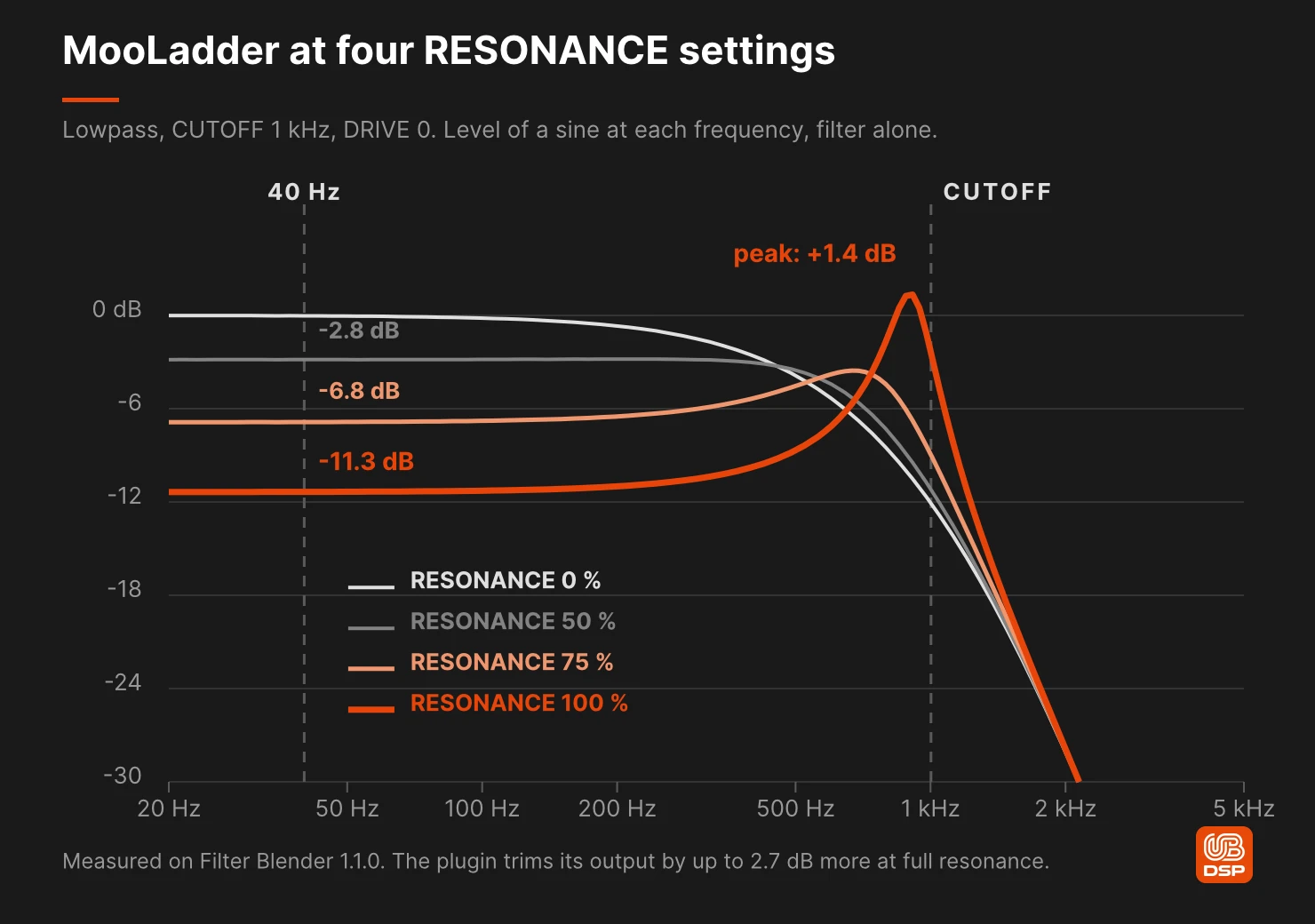
Three things to take from those numbers.
RESONANCE at 100 % is not quite the edge of singing. It costs 11.3 dB, not 14, because at DRIVE zero the loop gain stops short of 4. On this plugin DRIVE also feeds the resonance, which is why no model sings with DRIVE at zero. So the last few dB of bass are the price of the tone that sings, and you pay them on purpose.
The peak is mostly the bass going away. At full resonance and DRIVE zero, the top of MooLadder's peak sits only about 1.4 dB above where the passband started, while the bass at 40 Hz is down 11.3 dB. What sounds like a big resonant peak is, on this filter, mostly everything underneath being pulled down.
The last column is the plugin, and it's deliberate. Filter Blender turns its own output down a little as the resonance rises, on every model, so the RESONANCE knob doesn't double as a volume knob: about 3 dB on broadband material at full resonance. At 40 Hz on MooLadder that's another 2.7 dB. Keep it in mind for mechanism two, because it's the same thing, done on purpose.
Plenty of filters keep their bass
The main argument in that thread goes away once you look at what else exists.
Some filters compensate by design. Roland's Juno 6 feeds more input into the filter as you turn the resonance up, specifically to counter this drop in the passband, and its filter is basically the same design as the Jupiter 8's. The SH-101 goes the other way and raises its output level instead.
A state-variable filter doesn't have the problem in the first place. Its resonance is damping on an internal path, not a subtraction at the input, so the lowpass output keeps unity gain at DC however far you push Q. Nothing below the cutoff gets taken away, so there is no bass to lose.
The Steiner-Parker filter uses positive feedback instead of negative, and it is documented as keeping its level as the resonance rises. On Elby's reproduction of that circuit, the gain actually goes up.
So "analog filters lose bass at high resonance" describes one family of circuits, which happens to include the most famous one. It says nothing about analog in general, and it doesn't mean the filter is cheap.
It gets messier, too. Elektron, describing the ladder in their Analog Four, say that zero resonance doesn't give the flattest response: "it drops some decibels both in the treble and in the bass", and the flattest setting is resonance around 25, which is their default. On that instrument, a little resonance gives you more bass, not less. Whatever the designer put around the core decides the curve, and the topology name won't tell you.
The fix
If you're in mechanism one, there are two ways out that keep the sound, and both come before any EQ.
Compensate at the input. Push the input up by roughly the (1 + k) the loop is taking out. That's what the Juno 6 does. The catch: the peak rises by the same amount, so anything downstream that reacts to peaks will react harder, and that puts you straight into mechanism two.
Or keep the bass out of the filter. More on that below. It's also the fix that works when the cause turns out to be one of the other two.
Mechanism two: the peak got loud and something took the level down
This is the common one, and the filter has nothing to do with it.
A resonant peak can add 12 dB or more in a narrow band. Feed that into anything that reacts to peak level and it pulls the whole signal down. A limiter does it. So does your own hand on the fader, usually within two seconds of hearing the peak. Then you listen back, hear less bass, and blame the filter.
In Filter Blender the limiter sits right after the three filters, not at the end of the chain. BRK holds the peaks around -0.2 dBFS, so when a resonant peak hits it, everything comes down, low end included.
The test is quick. Measure one band, not the whole output. Put a sine, or a band-pass meter, an octave or two below the cutoff, and sweep the resonance while you watch that one number. If it moves, you're in mechanism one. If it holds still while the overall level drops, you're in mechanism two, and the filter never touched your bass.
The fix is to stop level-matching by peak. Boosting the lows won't do it. Match by the band you care about, or by loudness, and set the limiter yourself instead of letting it decide your spectrum. Filter Blender has a LOUDNESS control for this. It corrects by up to 12 dB either way, so a resonant setting can't win a comparison just because it's louder.
Mechanism three: the bass is all there and the balance moved
This is the case people argue about, so I'll be careful about what I claim.
The arithmetic part is solid. Put a resonant peak at 800 Hz on a filter that doesn't subtract at the input, a state-variable lowpass for instance, level-match properly, and the band below 100 Hz hasn't moved. Not a little. At all. People will still tell you the bass went away.
Why that happens is about listening, and I won't pretend it's physics. A narrow, loud band dominates how you judge the whole sound, and once you're judging the peak you've stopped judging the bottom. That's the one place in this article where I'm describing what you hear rather than what I measured.
The test: level-match the two versions, then ask somebody else to switch between them while you look away. If the bass comes back when you can't see the resonance knob, it never left.
The fix goes on the peak. A narrow dip where the peak is, or a couple of dB less resonance, puts the balance back without adding anything to the low end. Boost the bass here and you end up with too much of everything.
This is a cousin of a question in the FAQ: why the resonant peak doesn't sit on the CUTOFF dot. On a resonant lowpass the peak usually sits below the frequency you set, by a few semitones up to more than an octave, and each model resonates in its own place. The display shows where the cutoff is. Your ears tell you where the filter went.
Why the recipes you find work about half the time
Put the three fixes side by side:
| Cause | What the signal did | Test | Fix |
|---|---|---|---|
| Feedback subtracts the input | Band below cutoff really dropped | Watch one low band while sweeping resonance | Input compensation, or split the bass out |
| Peak-referenced level | Everything dropped together | Band is steady, output level fell | Match by band or loudness, set the limiter yourself |
| Balance, not level | Nothing below the cutoff moved | Level-matched blind A/B | Tame the peak, do not boost the bass |
Most advice in circulation is the right fix for one row and the wrong one for the other two. Boost the lows after the filter and you're right for row one, overdoing it for row two, and making row three worse. That's why a tip from a forum thread works for one person and not the next. Nobody is lying. They're each describing a different row.
The clean compensation, and the trap in doing it yourself
For row one, the fix that keeps the character works in parallel: take the low end out before the filter and put it back after. You keep the resonance without paying for it in the bass, and you haven't drawn one curve to cancel another.
You can build this in a DAW with two tracks and a pair of crossover filters, and that's where the trap is. The two paths have to arrive in phase and at the same time. Get it slightly wrong and you've swapped a 10 dB loss for a comb filter, which is harder to hear and much harder to undo. If you build it by hand, check the null: feed the same signal to both sides, flip the polarity on one, and make sure the bypassed version cancels.
Filter Blender does this internally with LOWS: a 24 dB per octave split where the low band skips the filters, the effects and the limiter, and rejoins before the output. The manual suggests 80 to 120 Hz on a bass line and 150 to 250 Hz on a drum bus or a full mix, and the controls section explains it better than I would here.
One caveat, because a crossover isn't a wall. Set the split at 100 Hz and a 50 Hz fundamental goes mostly to the clean band, but its harmonics from 150 Hz up still go through the filter and still get subtracted. LOWS protects a region, not a note.
One more place this shows up, with a different symptom
If you push a resonant filter with a fast envelope and the note sounds briefly flat rather than thin, that's a different mechanism with the same culprit. Resonance makes the filter's delay around the cutoff taller, and moving the cutoff through it shifts the pitch you hear. On a C2 with the cutoff sweeping down over one second, I measured about 58 cents of flattening with no resonant peak, 84 cents at a Q of 1, and around 130 cents at a Q of 1.5. It's all in Why a Fast Filter Envelope Pulls Your Note Out of Tune, including why it's the bass that complains and not the lead.
The two are worth keeping apart. One costs you level, the other costs you tuning, and raising the resonance buys you both.
Choosing a filter, and fixing the one you have
If you're choosing a filter, don't treat passband loss as a quality score. Find out whether the design compensates, and decide whether you want it to. A filter that holds its bass while the resonance climbs is easier to mix. A filter that gets lighter as it opens up is more fun to play, and sometimes lighter is the sound.
If you're using one you already have, run the one-band test before you touch an EQ. A minute of it tells you which row you're in, and then you're fixing the thing that's actually broken.
And if the bass never left, there's a nice moment on the other side of that test. You stop fighting the low end, take two dB off the resonance instead, and the part settles into the mix with the peak still singing on top. That's the sound you were after when you reached for the knob.
Frequently asked questions
Why does my filter lose bass when I turn up the resonance?
On a lowpass with global negative feedback, such as a transistor ladder, the resonance control raises how much of the output is subtracted from the input. Well below the cutoff the signal passes through the stages unchanged, so what comes back is close to the input itself, and the passband gain becomes 1 / (1 + k), where k is the feedback amount. At the point where the filter starts to self-oscillate, k is 4 on a four-pole loop, so the passband is 14 dB down. In this case the bass really is gone from the signal.
Do all analog filters lose bass with high resonance?
No. It is a property of one family, lowpass filters with global negative feedback, which happens to include the most copied design. Many filters compensate on purpose: Roland's Juno 6 raises its input as the resonance goes up, and the SH-101 raises its output. A state-variable lowpass keeps unity gain at DC at any Q, because its resonance is damping rather than a subtraction at the input. The Steiner-Parker filter, built on positive feedback, keeps its level as the resonance rises.
How much bass does a ladder filter lose at full resonance?
Up to about 14 dB at the edge of self-oscillation, which is what 1 / (1 + 4) comes to. Measured on Filter Blender's MooLadder at 40 Hz with DRIVE at zero, it is 2.8 dB at RESONANCE 50 %, 6.8 dB at 75 % and 11.3 dB at 100 %, within a tenth of a dB of the arithmetic. The plugin also turns its output down a little as the resonance rises, which brings the total at 40 Hz to 14 dB at full resonance.
How do you compensate for bass loss from resonance?
Two ways keep the sound intact. Compensate at the input, raising the level going in by roughly the amount the loop takes out, which is what the Juno 6 does. The peak then rises by the same amount. Or split the low band off before the filter and sum it back afterwards, which costs nothing in character but needs the two paths to stay in phase. Boosting the bass with an EQ after the filter is the third option and the worst one, because it also boosts whatever the filter left behind.
Is the bass actually gone, or does it only sound that way?
Both happen, and they need different fixes, so test rather than guess. Put a meter on one band an octave or two below the cutoff and sweep the resonance. If that band drops, the filter is subtracting and you need compensation. If the band holds steady but the whole output got quieter, something downstream pulled the level because the peak got loud. If nothing moved and it still sounds thin, it is the balance, and the fix belongs on the peak.
Does raising resonance on a state-variable filter cut the lows?
Not at the lowpass output. In that topology the resonance sets the damping of an internal integrator loop, and the lowpass output has unity gain at DC whatever the Q. The bandpass and highpass outputs are a different matter, and so is any level compensation the designer put around the filter, which can move things either way.
Why does my filter only sound thin after the limiter?
Because a resonant peak is a loud, narrow band, and a limiter reacting to it pulls the whole signal down, lows included. The filter never touched the bass. Check by bypassing the limiter and matching level by ear or by loudness instead of by peak.
Sources
- Elektronauts forum, "A question for the filter specialists", 23 August 2023, for the question and the disagreement: 25 replies and no conclusion, with one side calling the bass loss a natural property of analog filters, another limiting it to Moog ladders and their copies, and a third calling it a design consideration in all types of filters.
- Elektron, "Filters", section "The Analog Four MkI/MkII, and Analog Keys filters", for the ladder whose flattest response is at resonance 25 rather than 0.
- Tom Wiltshire, "Roland filter designs with the IR3109 or AS3109", Electric Druid, May 2025, for the resonance compensation of the Juno 6 and the SH-101, and the Juno 6 filter's kinship with the Jupiter 8's.
- "Steiner-Parker Synthacon", Wikipedia, and Elby Designs, "Synthacon VCF", for the Steiner-Parker's level as the resonance rises.
- The passband relation and the oscillation threshold are standard feedback filter theory: a cascade of N identical one-pole stages with global negative feedback has passband gain 1 / (1 + k), and reaches 180 degrees of phase shift with enough gain to sustain at k = 4 for N = 4.
- The MooLadder figures and curves come from Filter Blender 1.1.0's own filter engine, measured on a sine in October 2026.
- UB DSP FAQ, "Why isn't the resonance peak on the CUTOFF dot?", and the Filter Blender manual, controls reference, for LOWS, LOUDNESS and the limiter.
- UB DSP, Why a Fast Filter Envelope Pulls Your Note Out of Tune, 7 October 2026, for the pitch figures at Q of 1 and 1.5.
Joy to use, joy to hear.
Ben, UB DSP